坏在张献忠拿荨麻擦了…… It Got Messed up 'Cause Zhang Xianzhong Wiped His… with Nettle
2024-ongoing
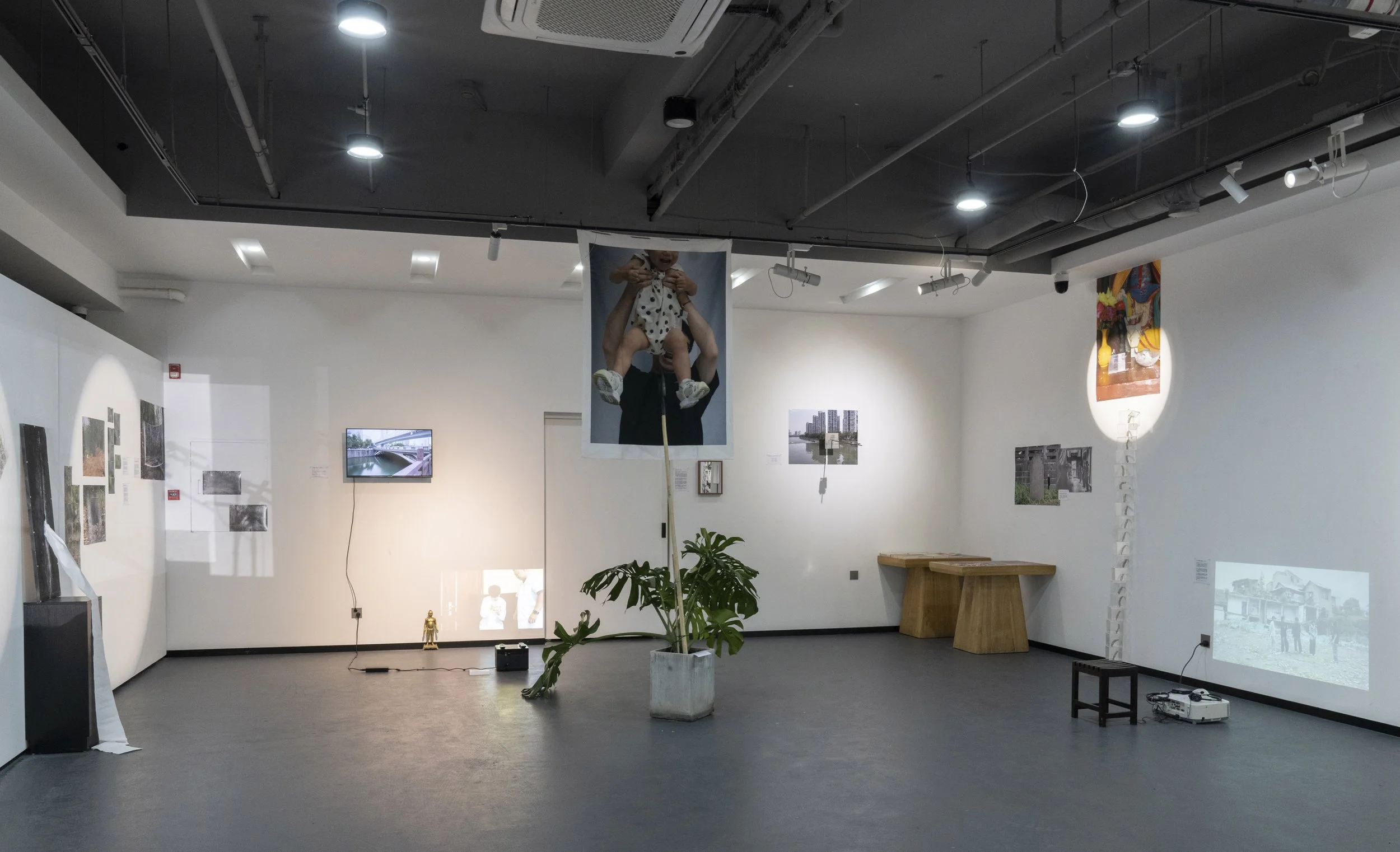
1644年前后,蜀地的关键词是张献忠屠川。同时期的战乱(涉及起义军、明兵、清兵)、盗匪、饥荒、虎患导致四川人口大规模减少,才有了后来的湖广填四川。这些历史造成了四川人口结构的变化,也让往后至今的四川人的身份溯源停留在了明清之际。
一方面,我(们)为何对那段历史中的屠戮产生不了太多的情绪反应?同样是暴力导致的大规模人口灭失,为什么我们的反应远不如谈及日军侵华或者奥斯维辛时那般强烈?只是因为时间太久了吗?
另一方面,如果没有此番战争之殇,是否就没有了我?这也是这次长期艺术实践的出发点。湖广填四川期间,从广东梅县迁至四川的祖辈让我的出现于世有了可能,但我作为“四川人”的身份认同又建立在原本的四川人被屠戮殆尽的前提之上。这一无关痛痒的怪诞处境也许是当下大多数四川人共有的。那么,四川人之于张献忠往事的“后记忆”是否存在?若是,在没有任何可供记忆生成的影像存在的情况下,“后记忆”又能否被激活?
基于正史、野史、族谱家乘对以张献忠为主的武装力量彼时“消灭”四川人口的记载,以及民间故事里对张献忠的批判和颂扬,这组作品试图通过不同方向的实践触碰上述问题。
相较于最终呈现于展场,这一系列的“作品”更多会发生、终结于白盒子之外的现实场合。至少,在地点上,我们尚且能假装回到过去。
Around 1644, the key event in Sichuan was Zhang Xianzhong's massacre of the province. The concurrent wars (involving rebel forces, Ming troops, and Qing troops), banditry, famine, and tiger attacks led to a significant reduction in Sichuan's population, which eventually led to the large-scale migration from Huguang (now Hunan and Hubei) and other provinces to Sichuan. These historical events have changed the demographic structure of Sichuan and have left the identity of Sichuanese people rooted in the Ming and Qing transition period.
On one hand, why do we not have much emotional response to the massacres of that time? Why is our reaction not as strong as when we talk about the Japanese invasion of China or the Holocaust? Is it just because of the passage of time?
On the other hand, if there had been no such war, would I exist? This is the starting point of this long-term artistic practice. During the "The Ming-Qing Sichuan Migration" period, my ancestors who moved from Meixian, Guangdong to Sichuan made my existence possible, but my identity as a "Sichuanese" is based on the premise that the original Sichuanese were almost all killed. This strange and indifferent situation might be shared by most Sichuanese people today. Then, does the "post-memory" of Sichuanese people towards Zhang Xianzhong's past exist? If so, can it be activated in the absence of any visual records to generate memory?
Based on the records in official and unofficial histories, genealogies, and family chronicles about the armed forces led by Zhang Xianzhong "eliminating" the population of Sichuan at that time, as well as the criticism and praise of Zhang Xianzhong in folk tales, this series of works attempts to touch upon the above questions through practices from different directions.
Compared to the final presentation in the exhibition space, these "works" more often occur and end in real-life settings outside the white cube. At least, in terms of location, we can still pretend to go back to the past.
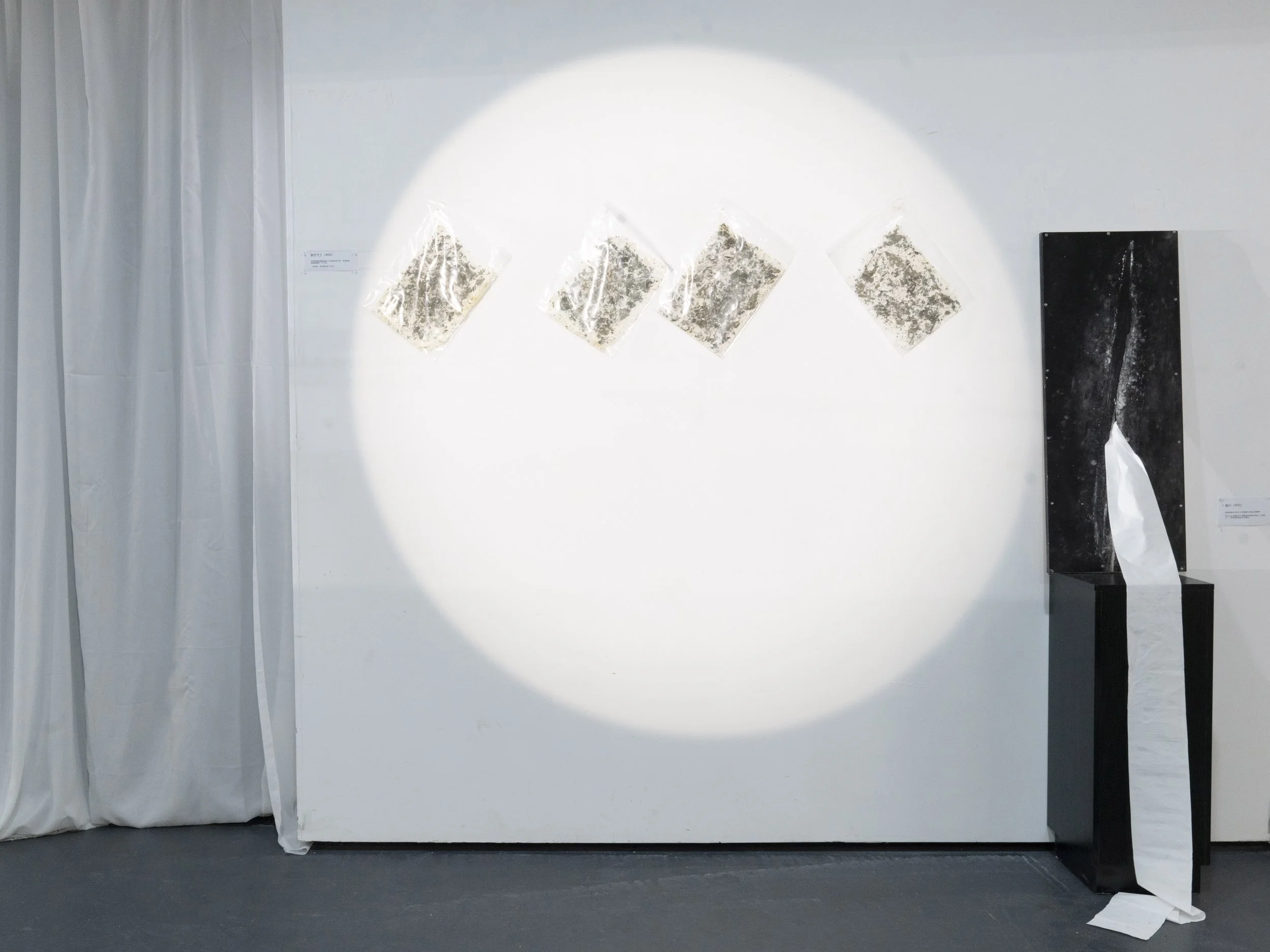
别生气了
Don't be Angry Any More
2025
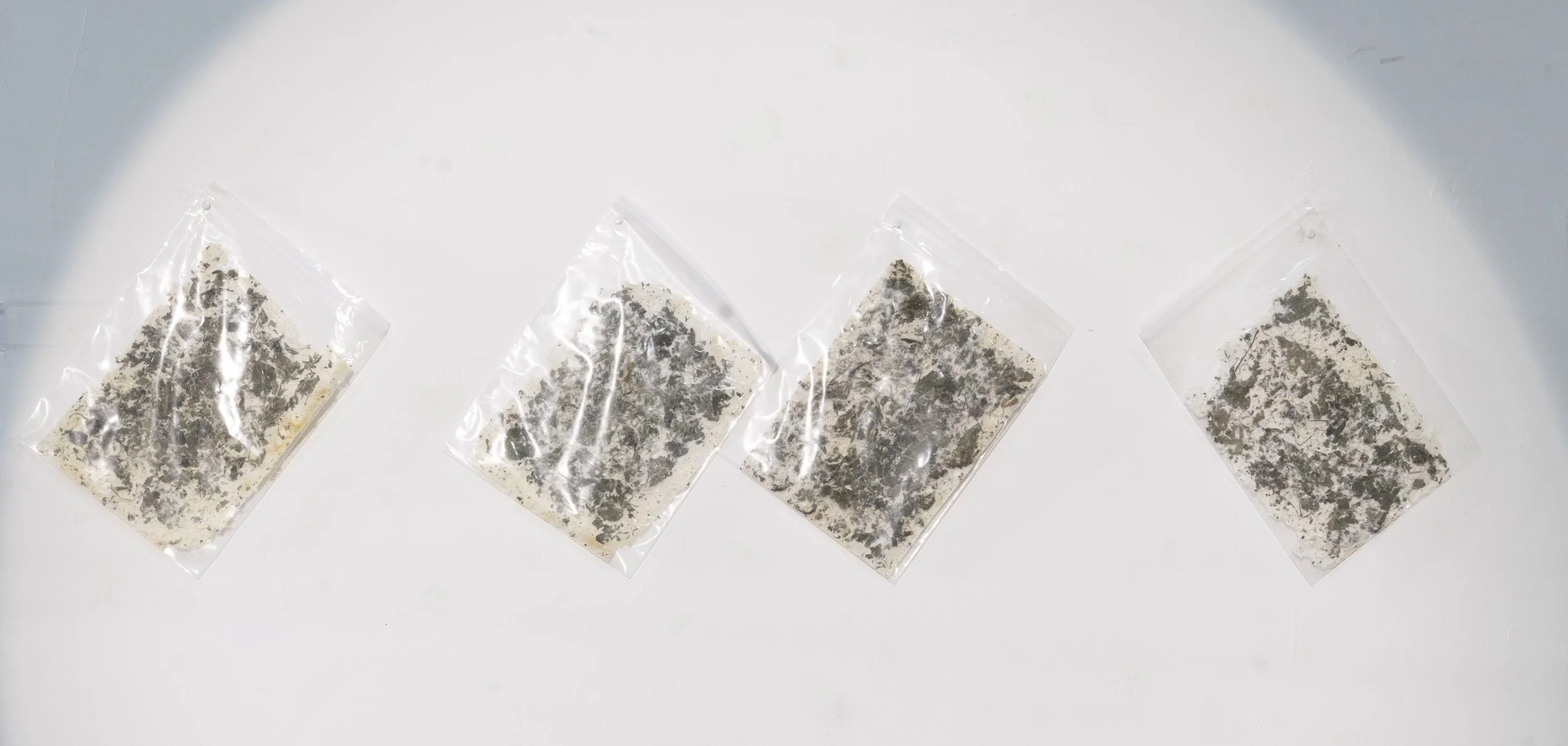
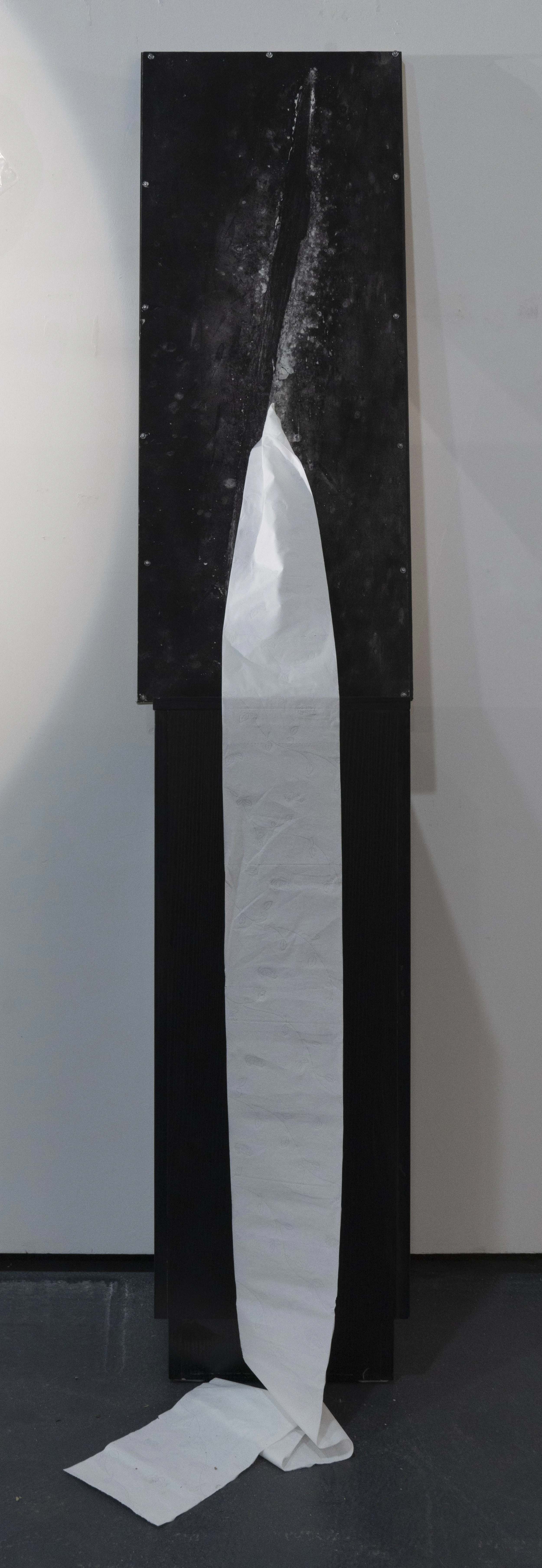
用荨麻和普通纸浆做了几张柔软的手纸,希望他使着能舒服些、开心些。
(若如此,是否就没有了历史?)
Several soft handkerchiefs were made using nettle and ordinary pulp, hoping that they would make him feel more comfortable and happy.
(If so, would that mean there is no history?)
创口
Wound
2025
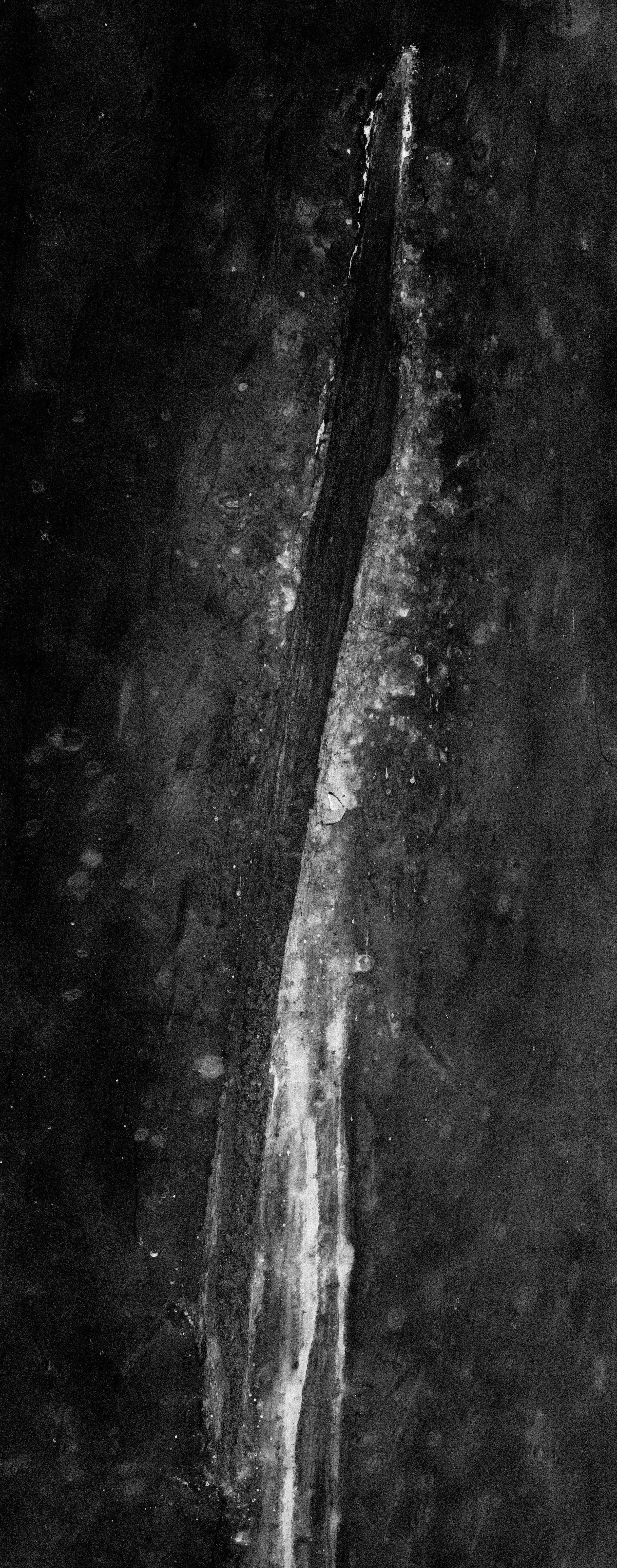
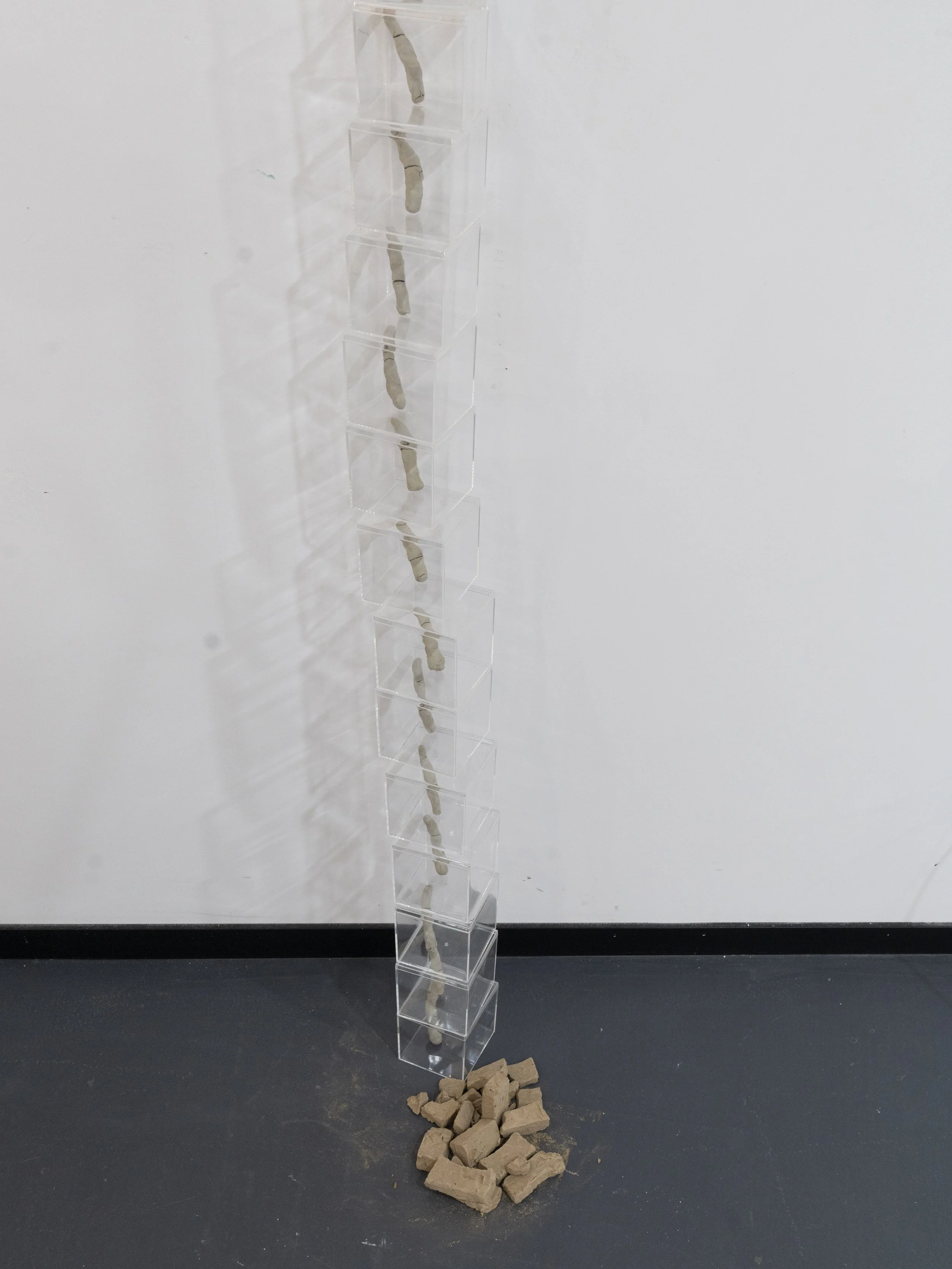
伤痕的象征在多久之后能被允许施以恶趣味?
有空可以去德阳市什邡慧剑寺看看这道柱子上的裂口——传说是张献忠用刀劈的。
How long will it be before the symbol of the scar is allowed to be associated with something vulgar?
When you have time, you can visit the Huijian Temple in Shifang, Deyang City. Take a look at the crack on this pillar - it is said that it was made by Zhang Xianzhong with a broadsword.
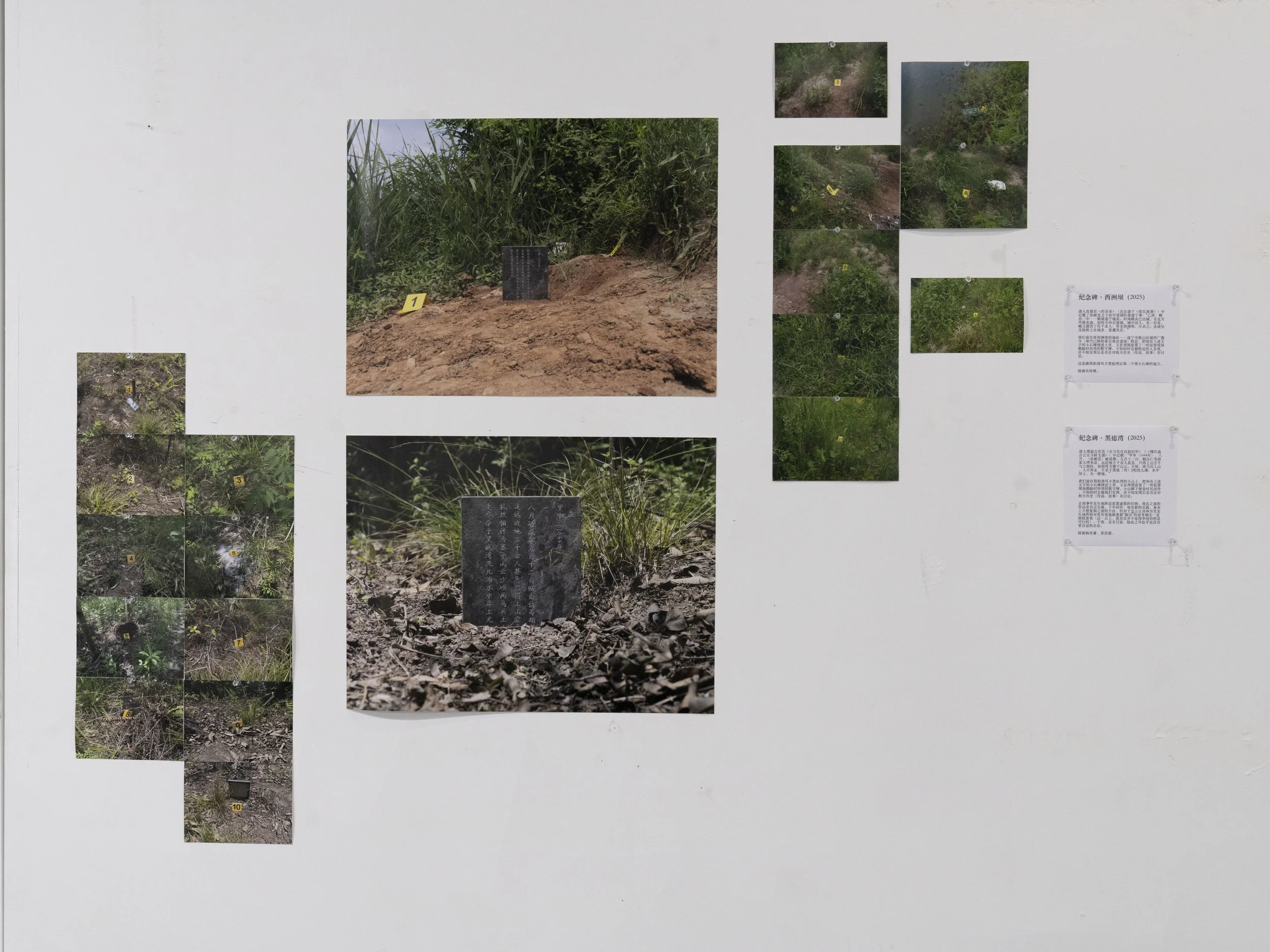
纪念碑·黑痣湾
Monument to Heizhi Bay
2025
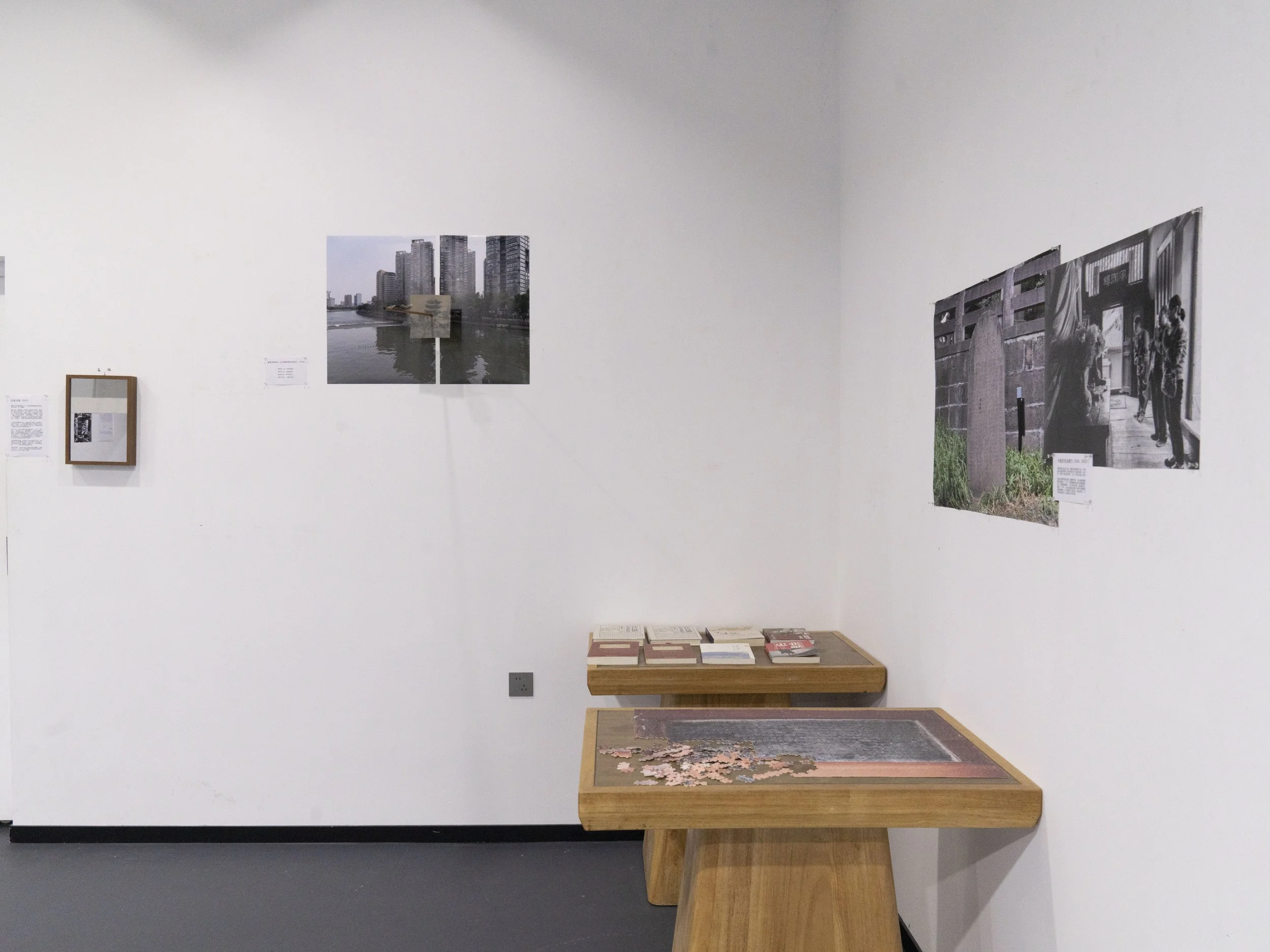
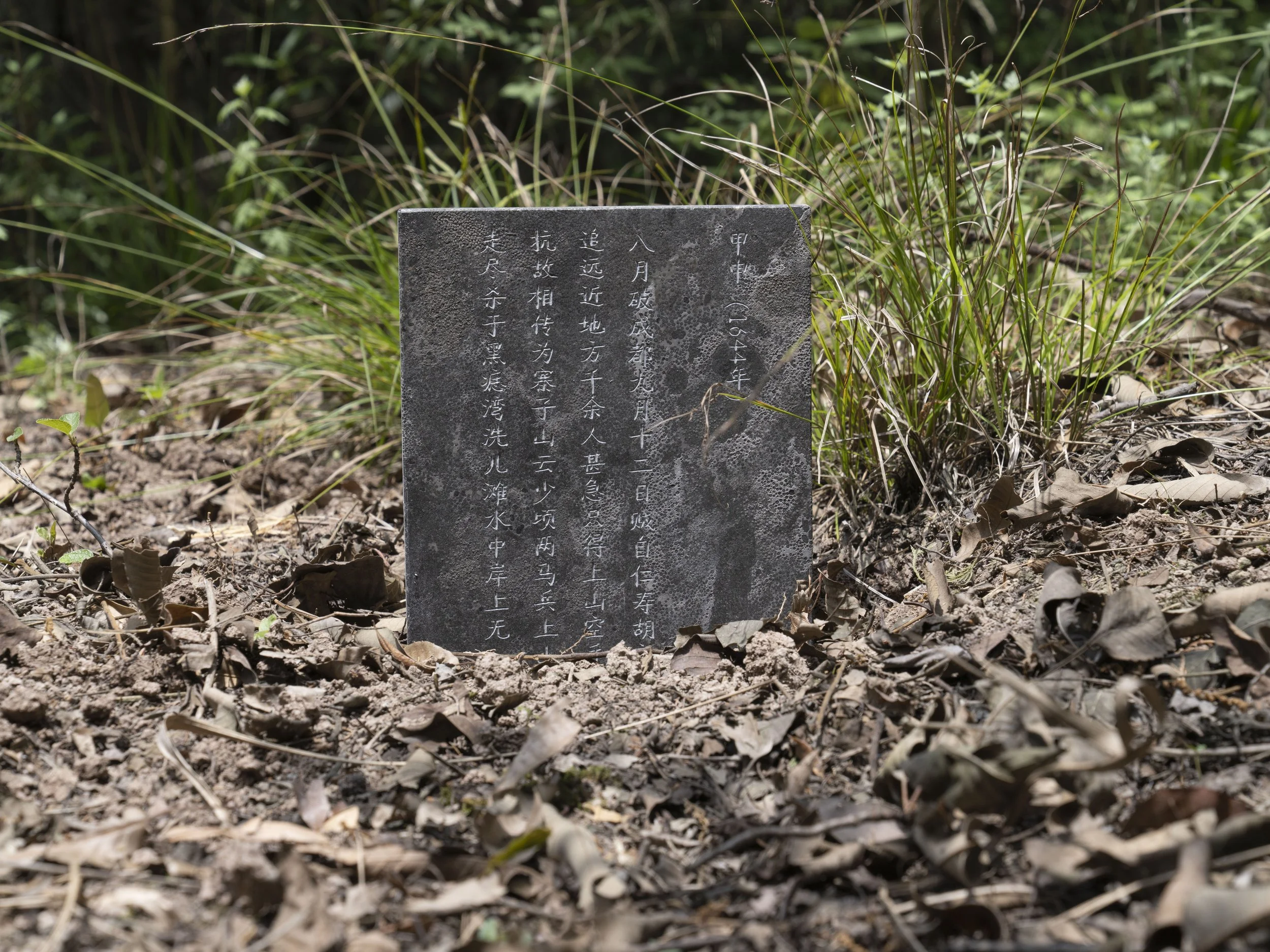
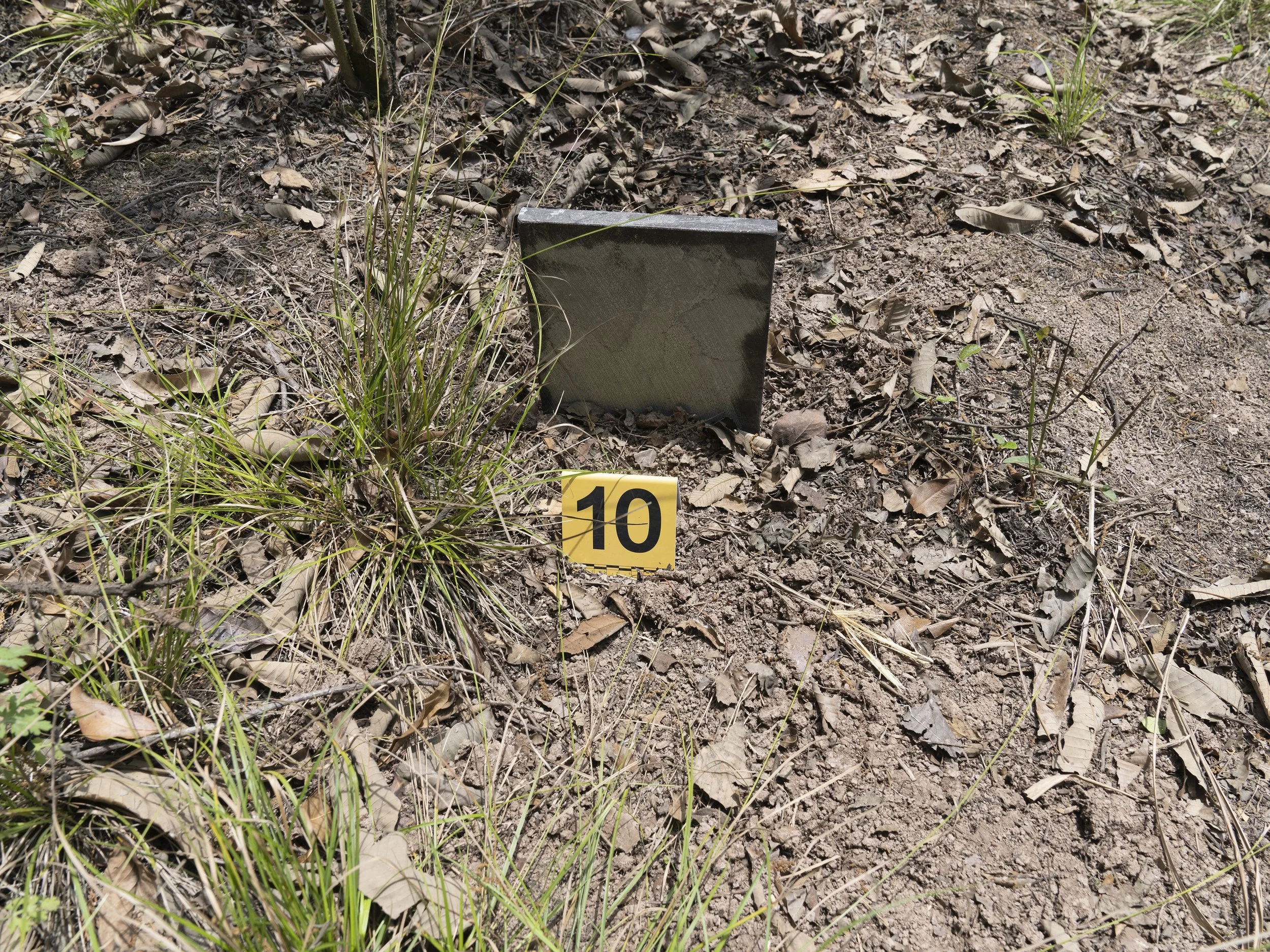
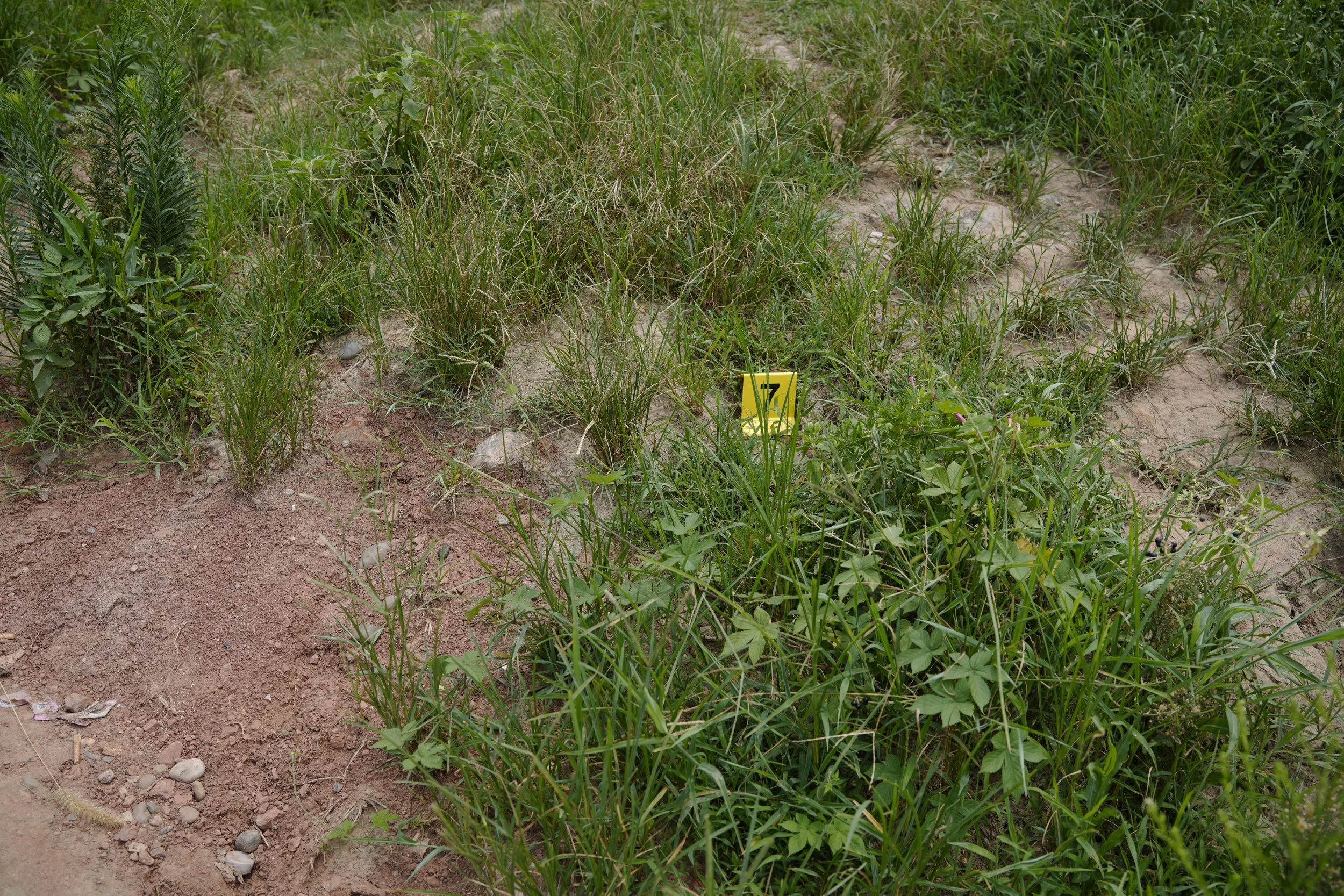
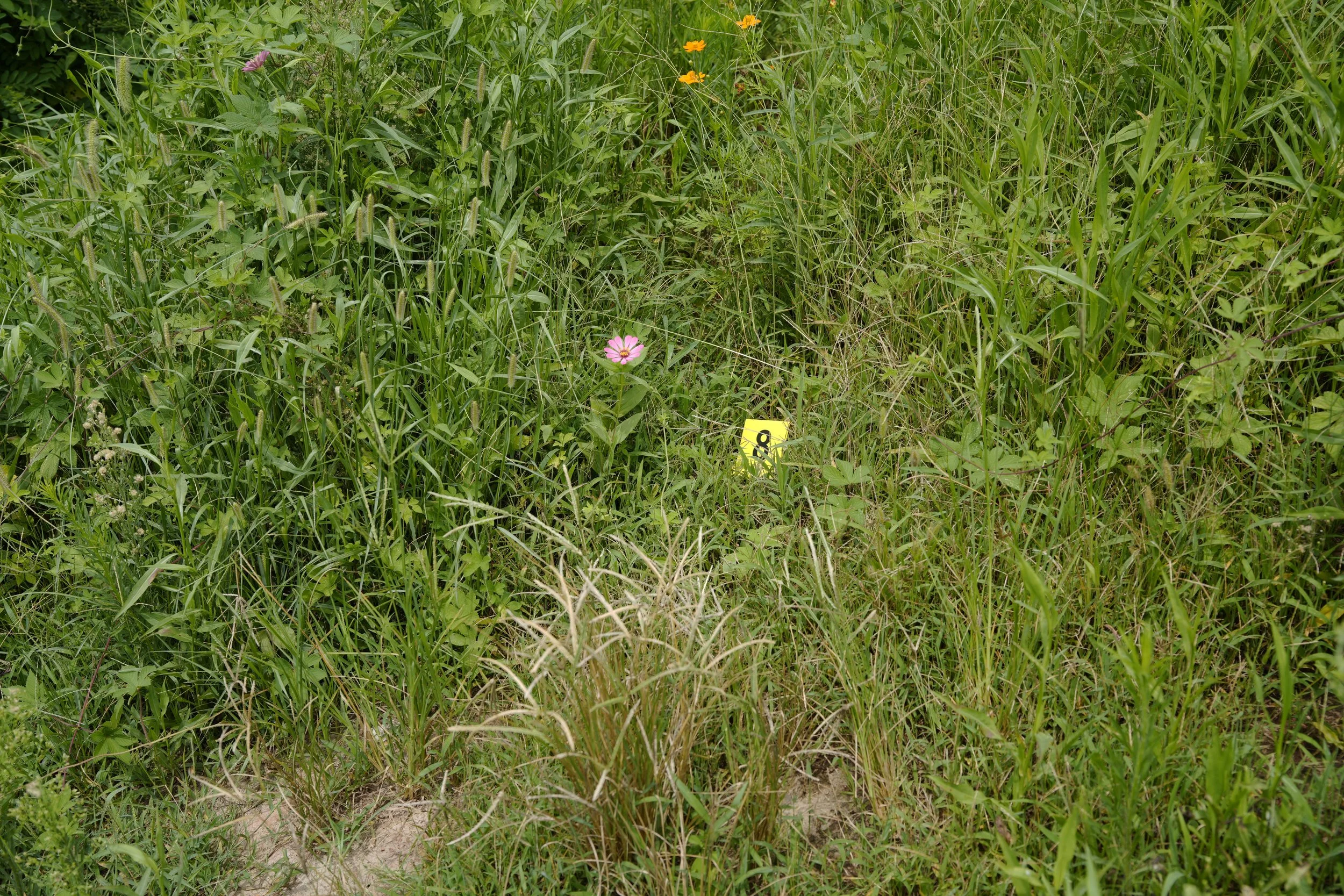
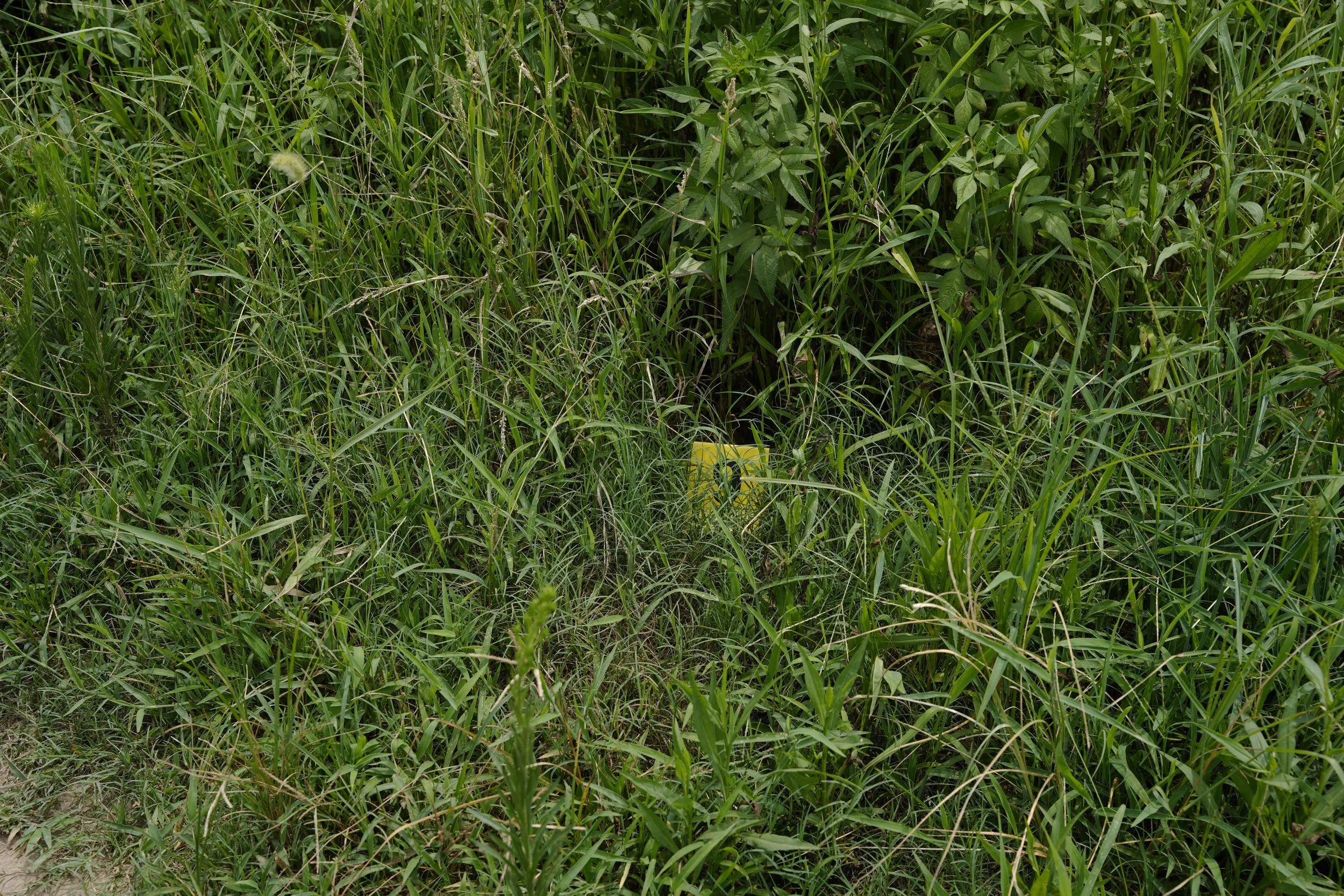
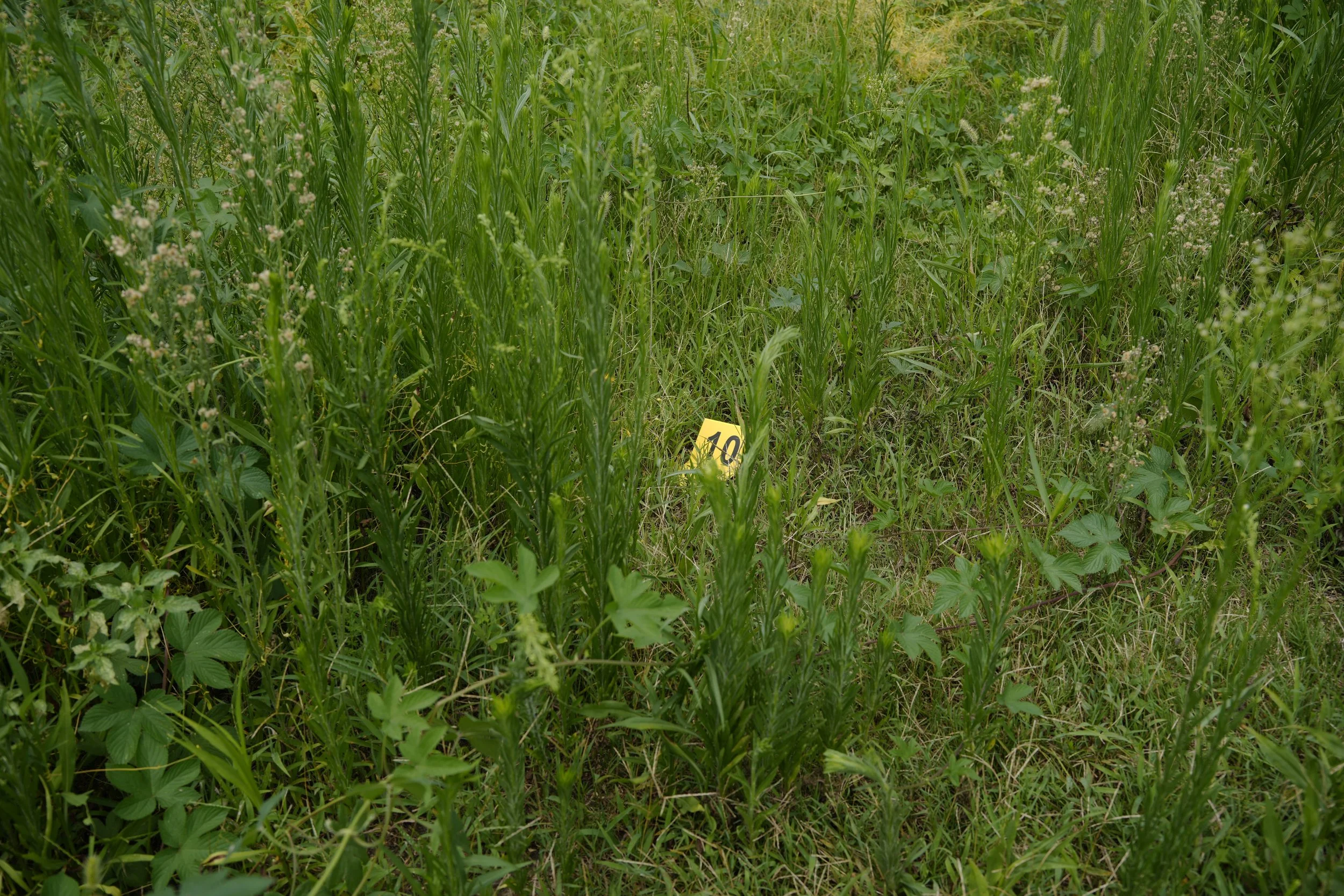
清人傅迪吉在其《五马先生自叙纪年》(《傅氏迪吉公五马桥支谱》)中记载:“甲申(1644年),八月,(张献忠)破成都。九月十二日,贼自仁寿胡家大湾来追,远近地方千余人甚急,只得上山空手与之相抗,故相传为寨子山云。少顷,两马兵上山,人尽奔走,尽杀于黑痣(弯)[湾]洗儿滩,水中岸上,无一隙地。”
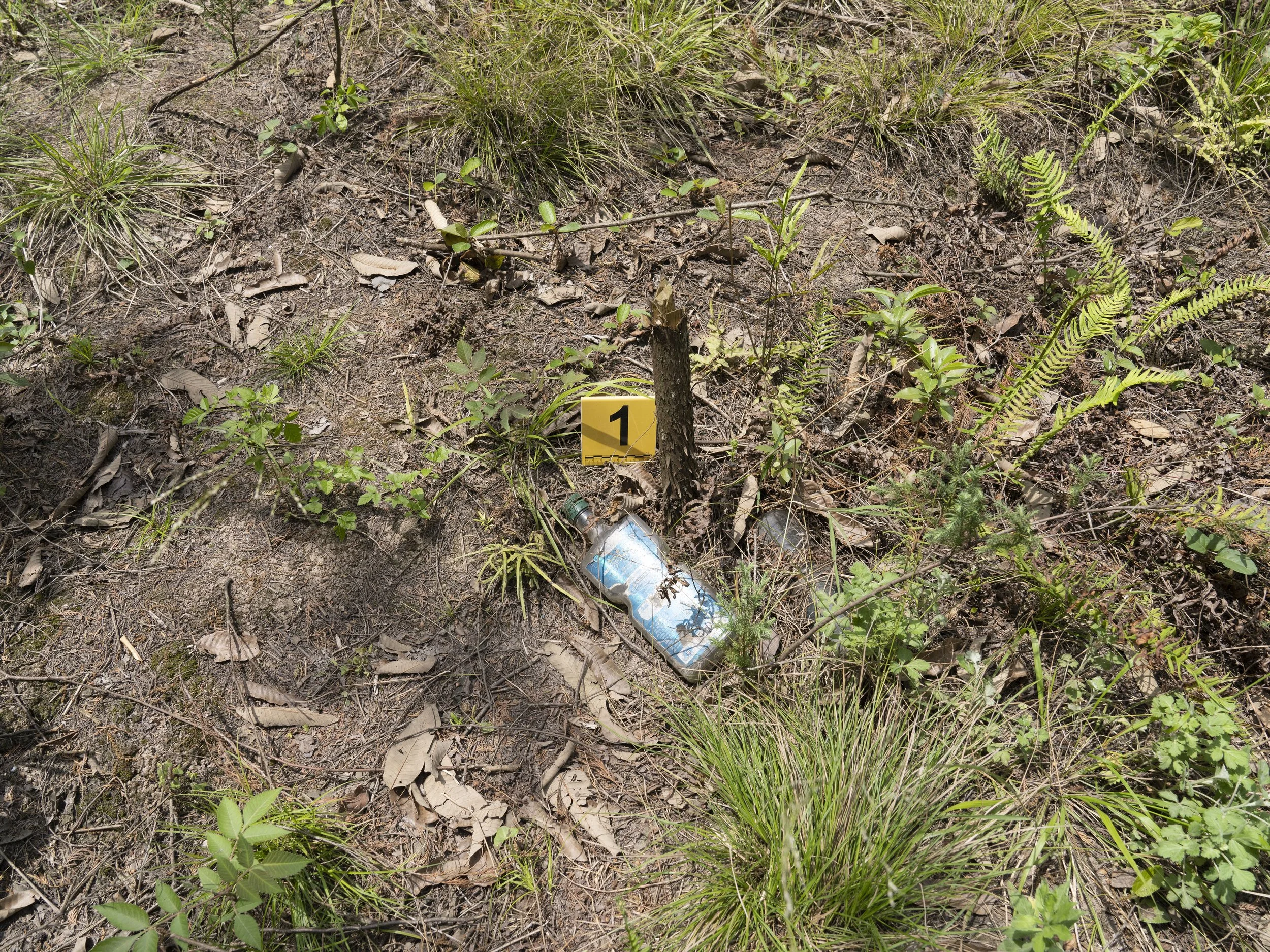
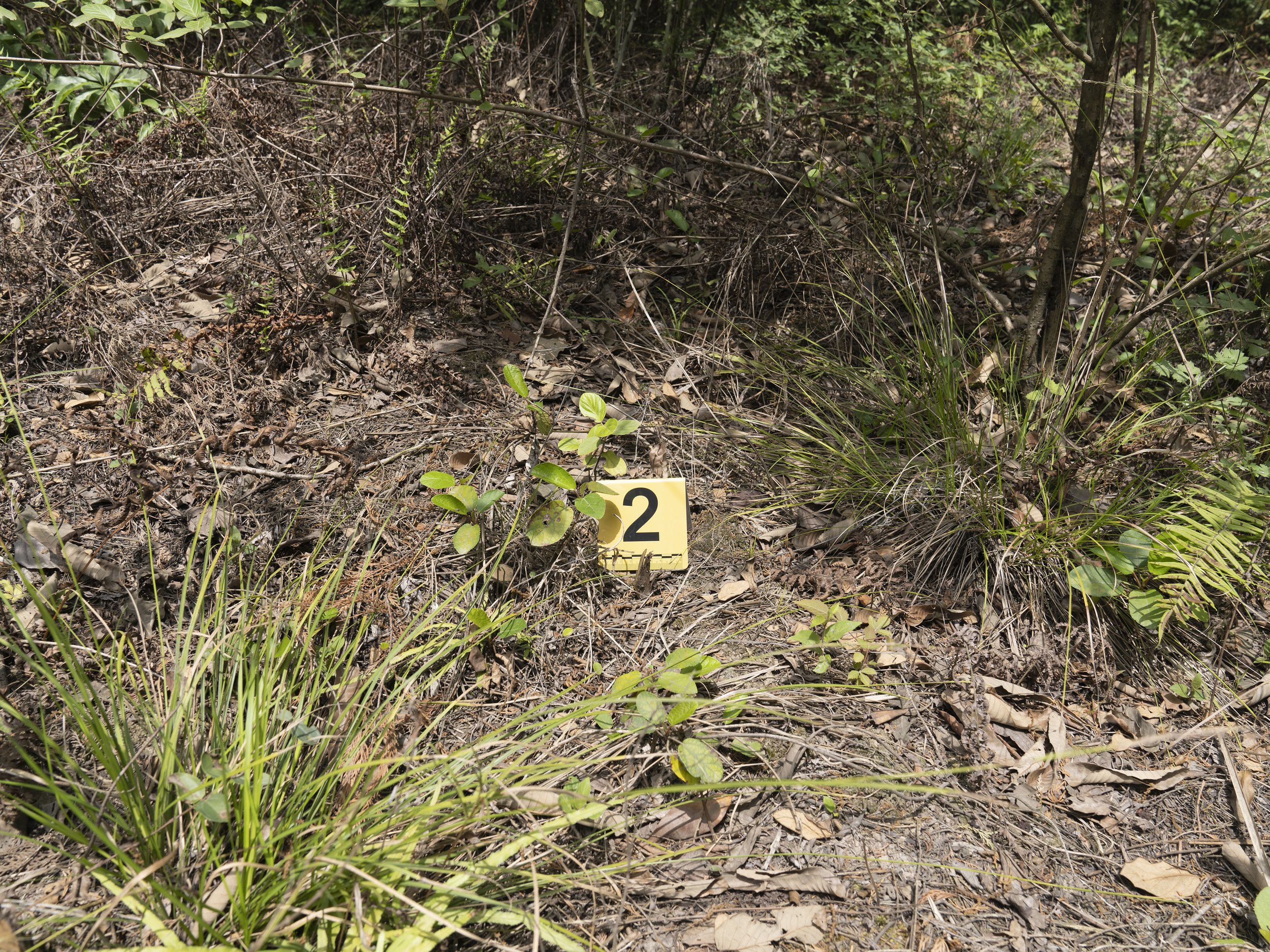
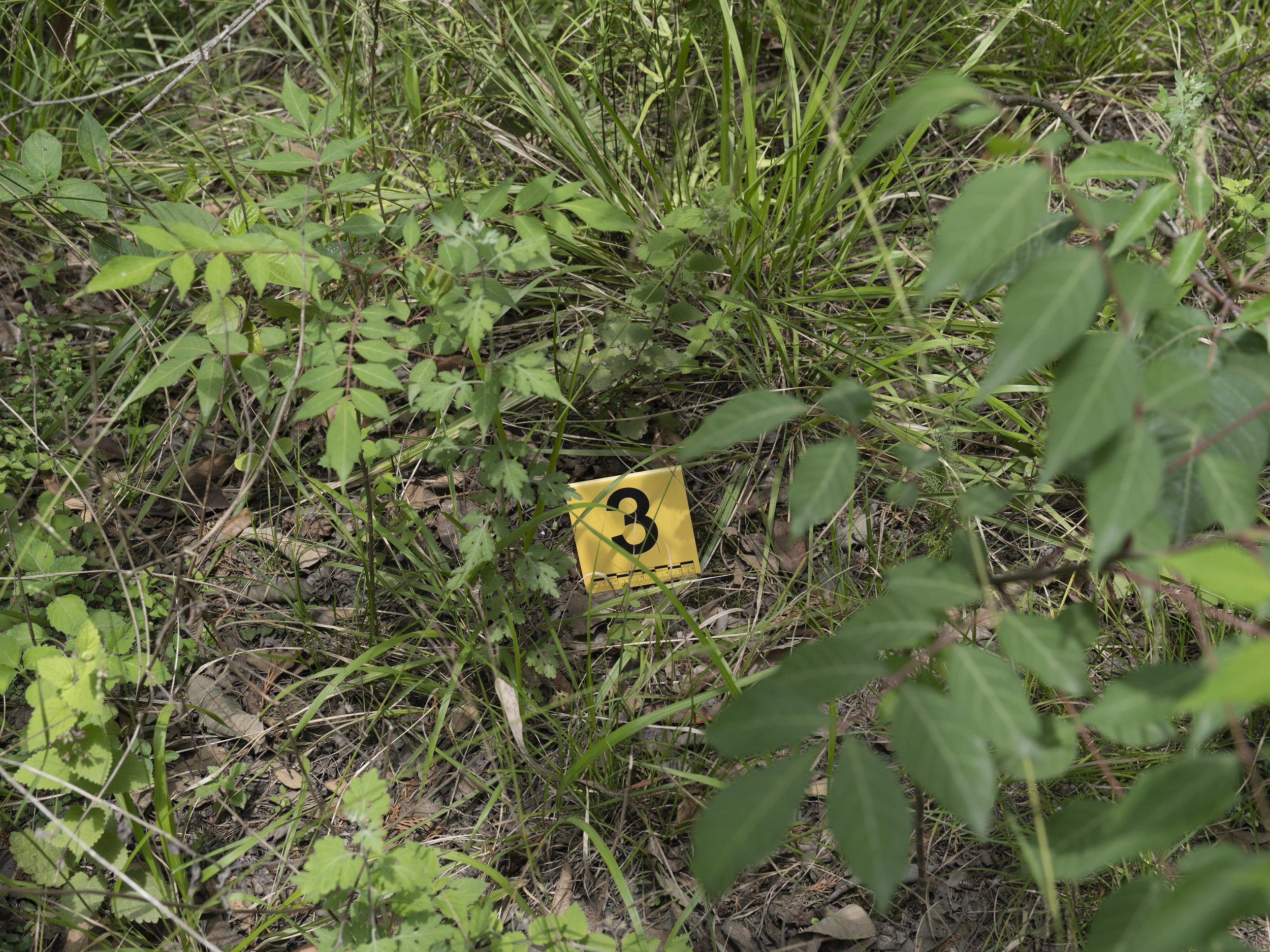
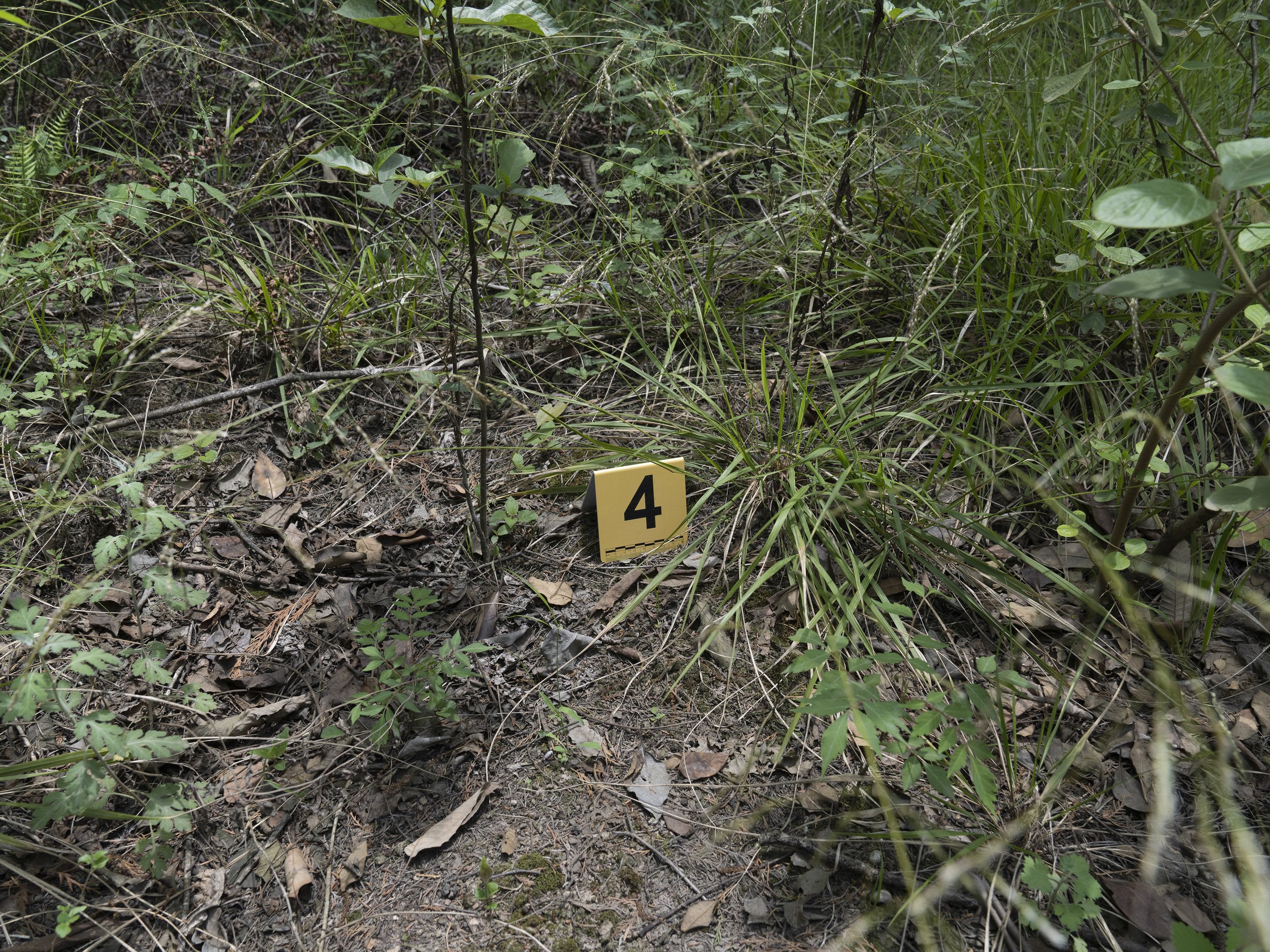
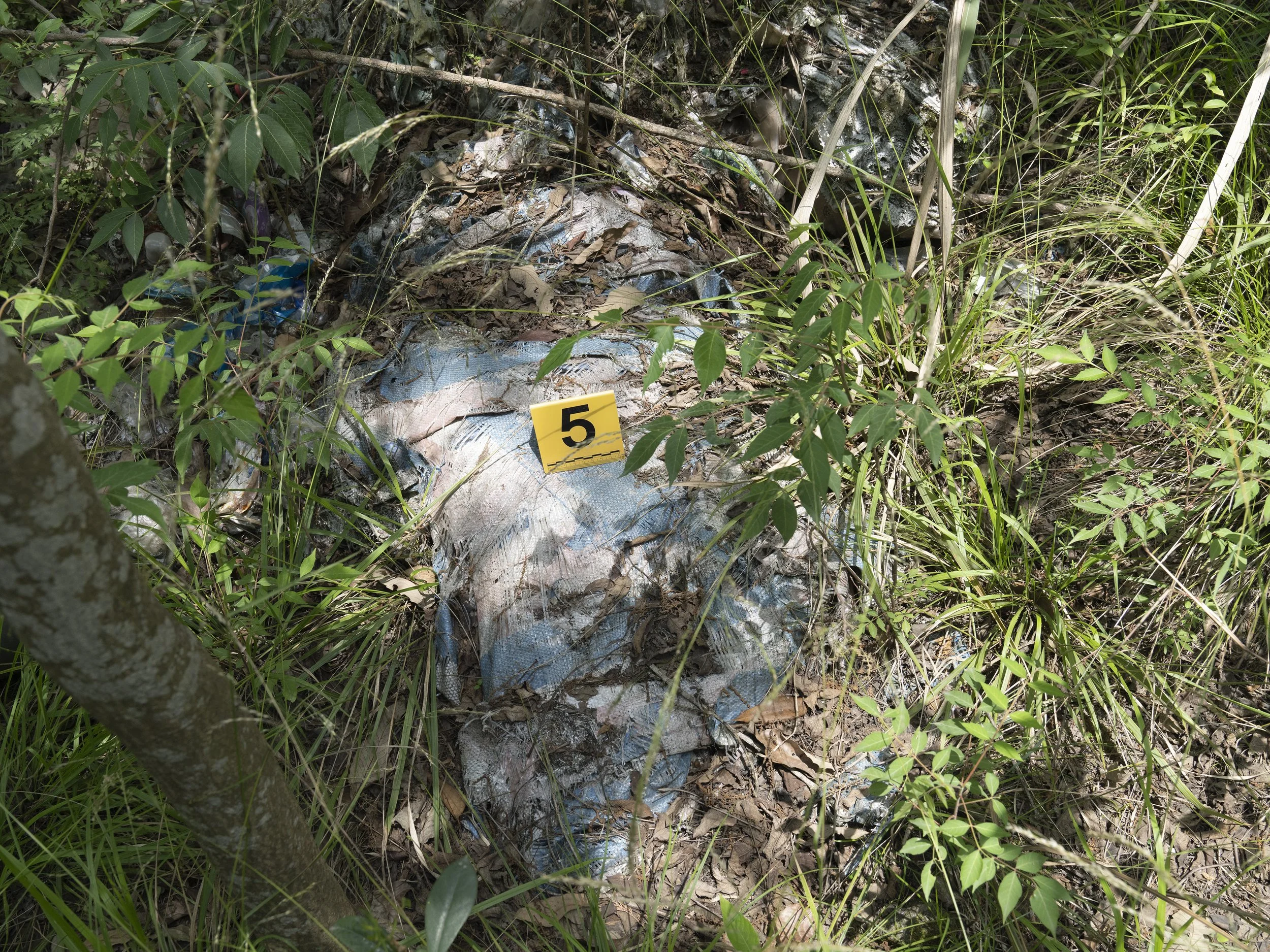
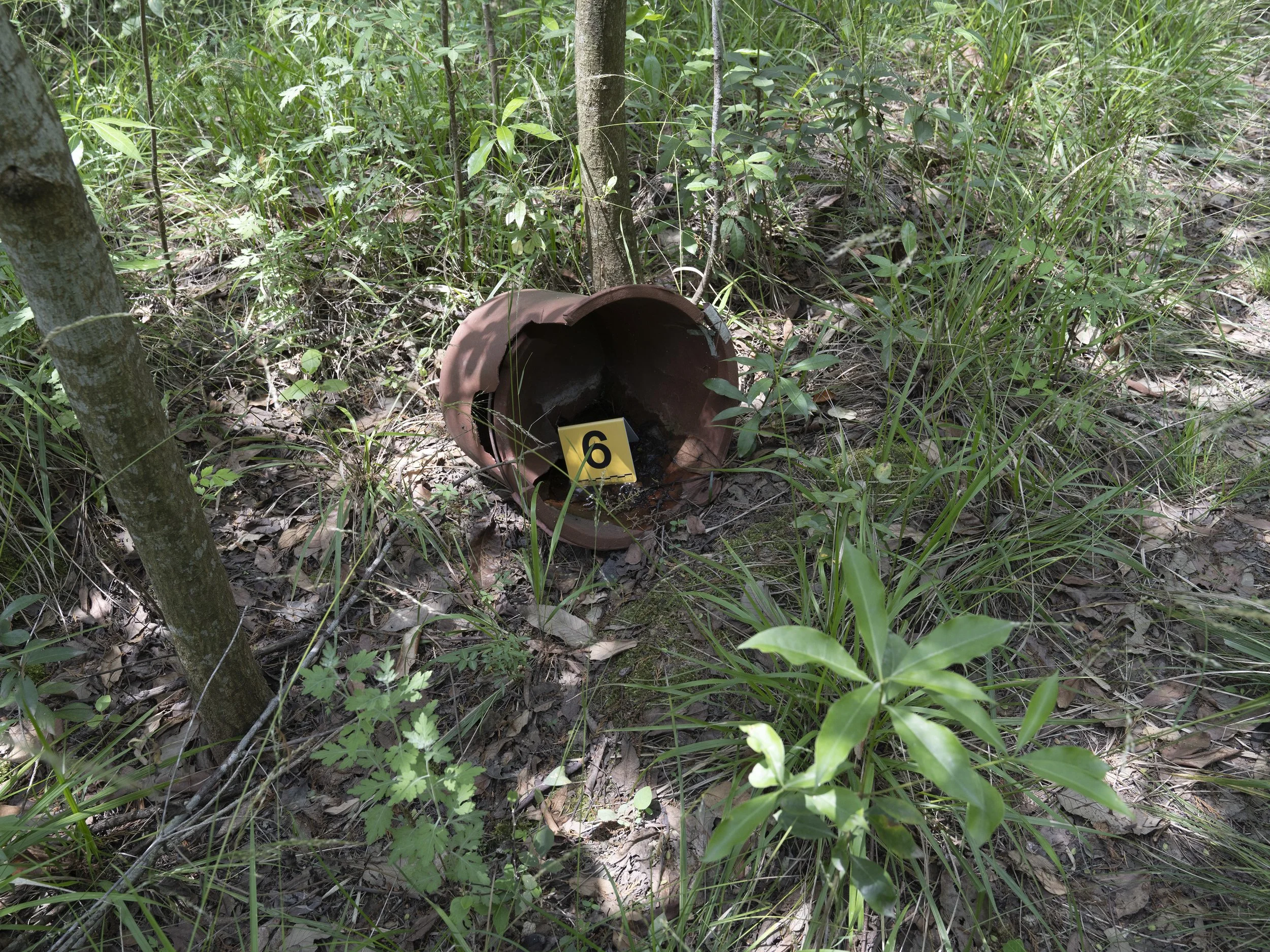
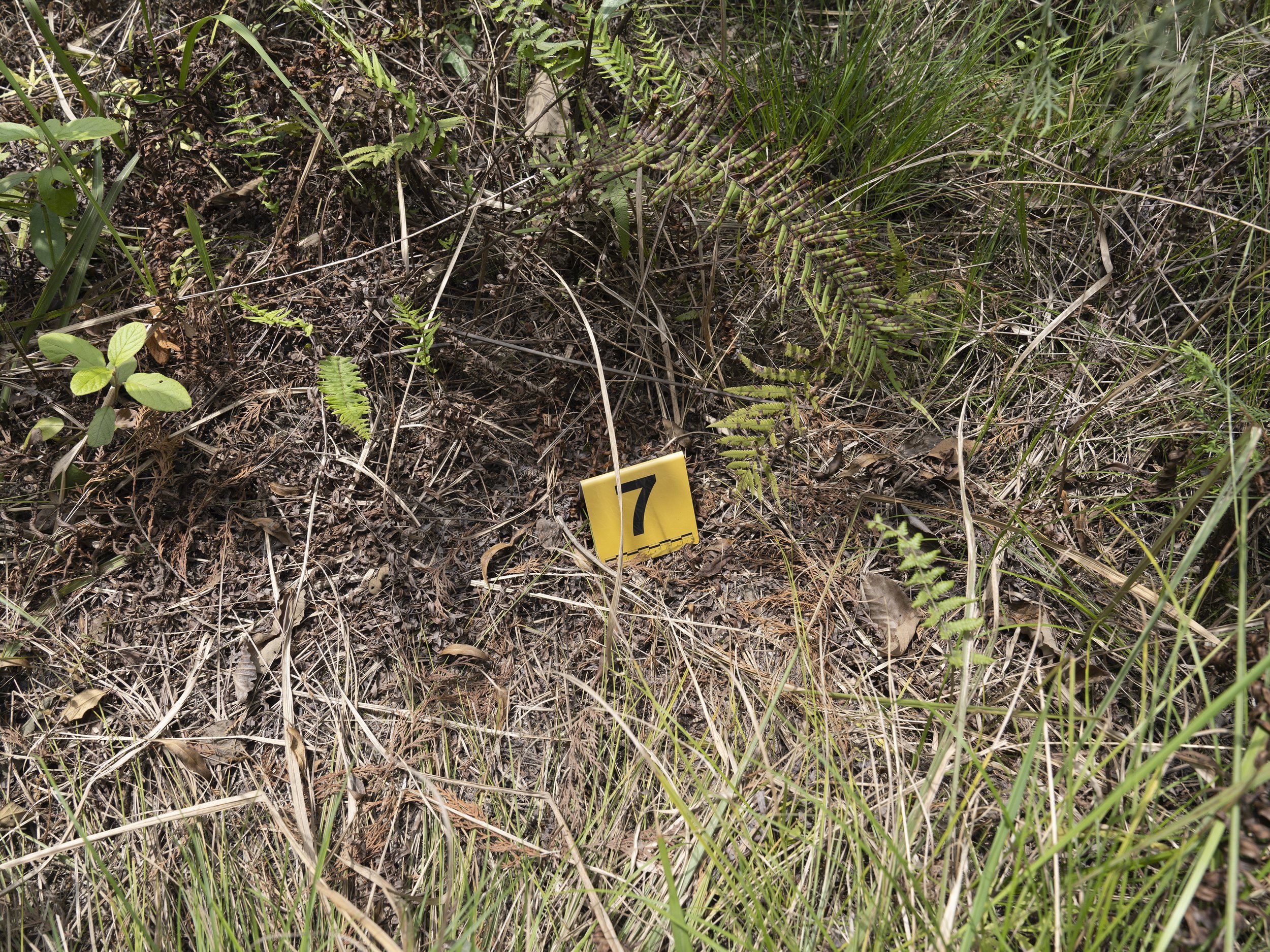
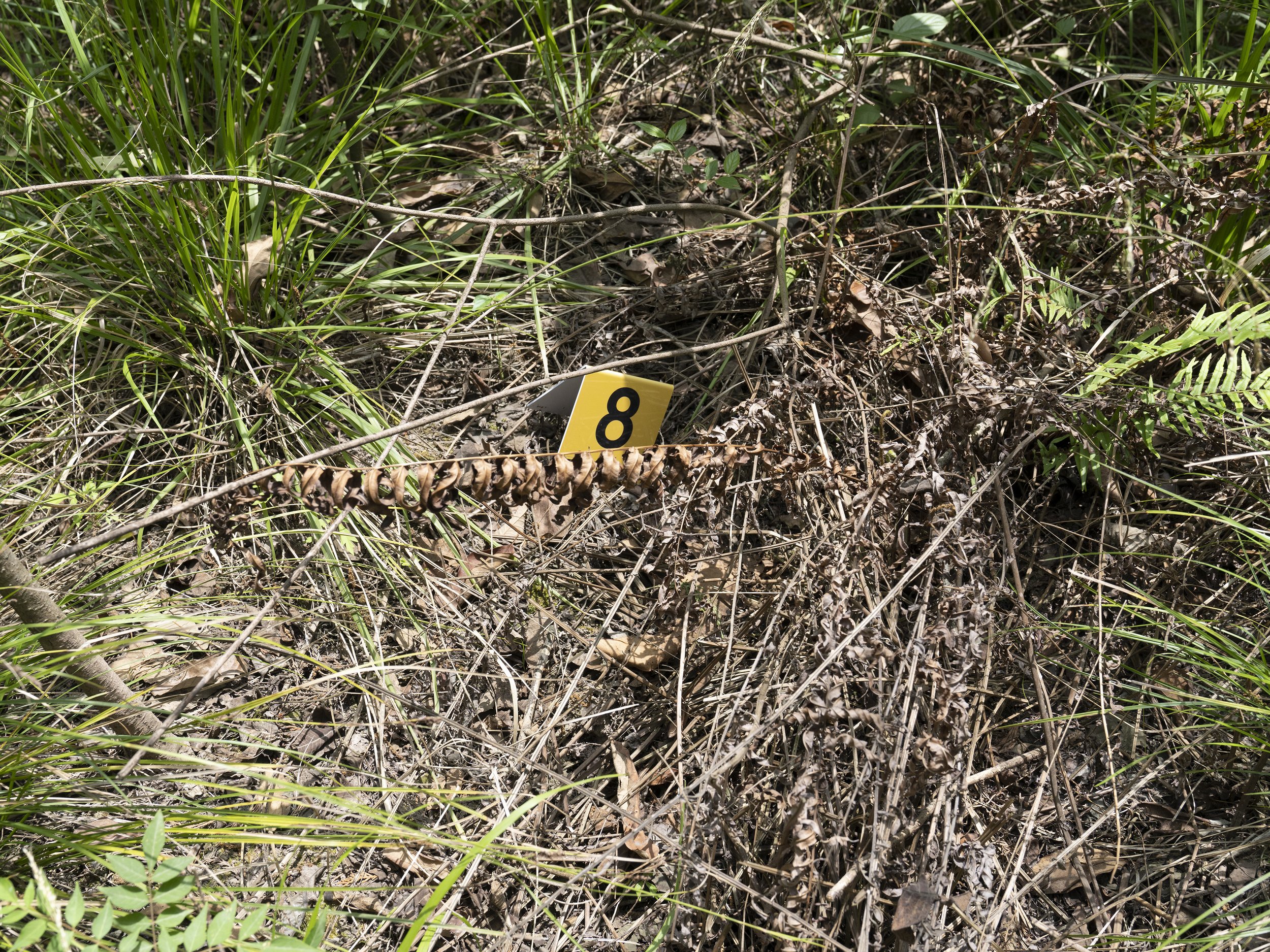
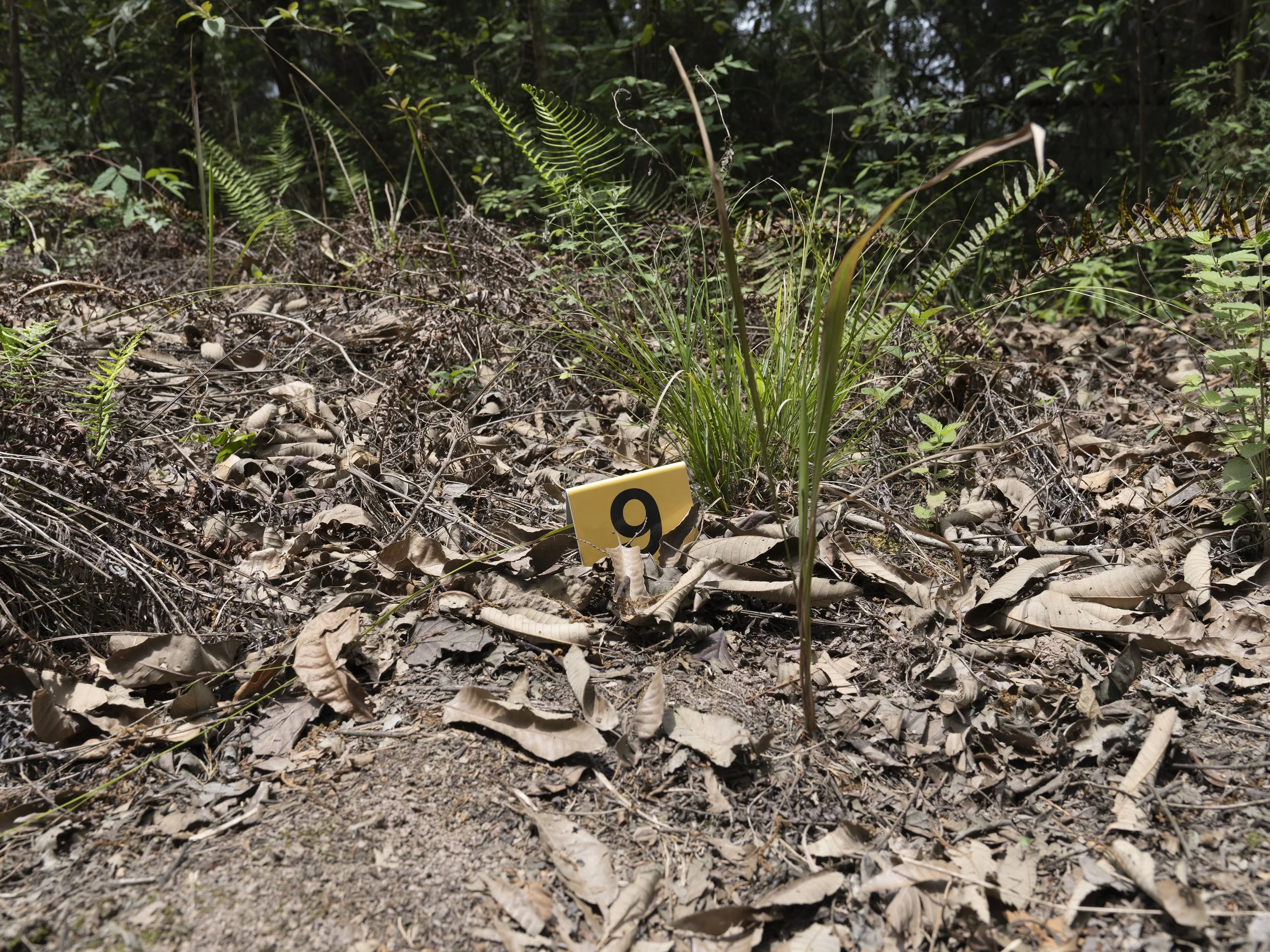
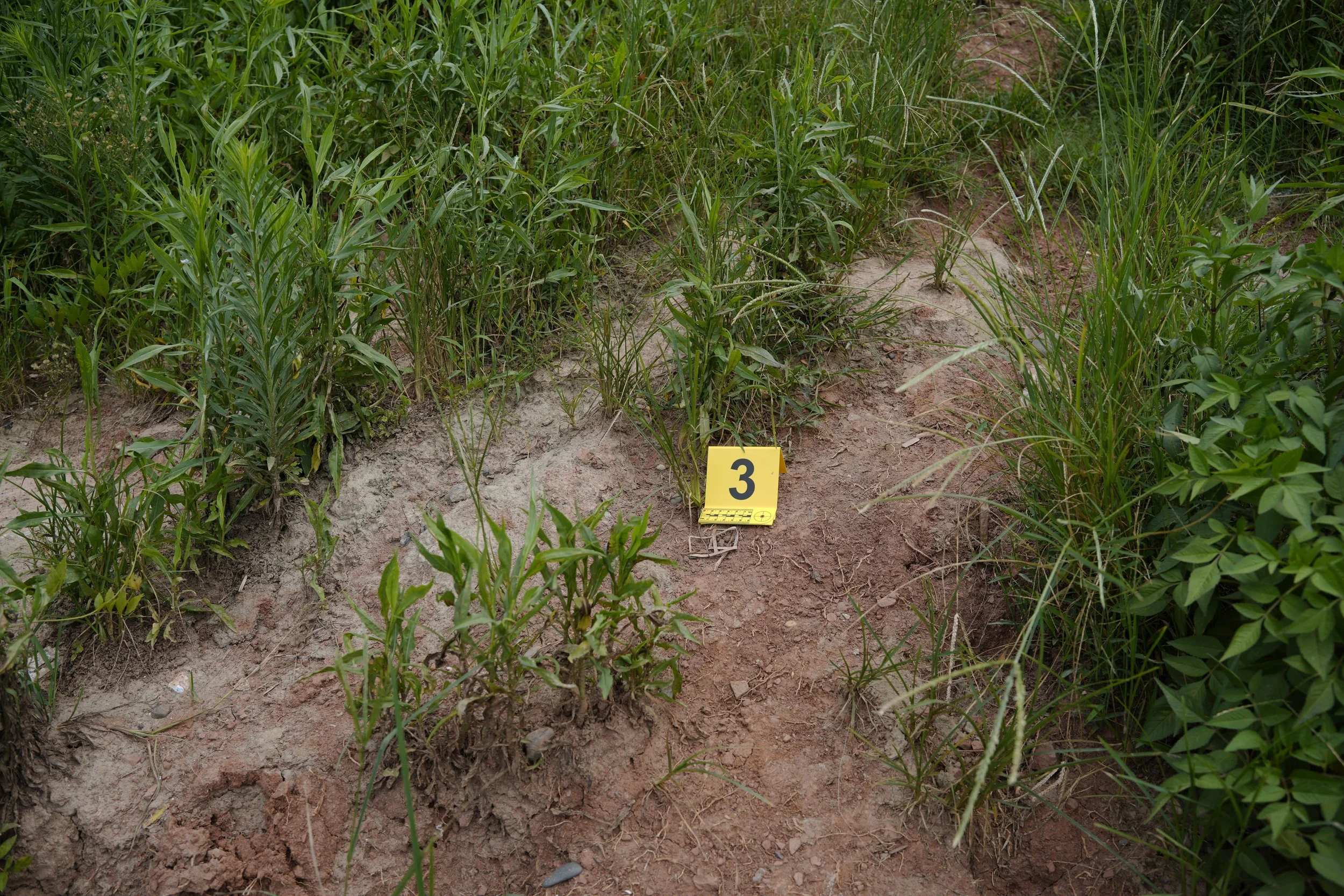
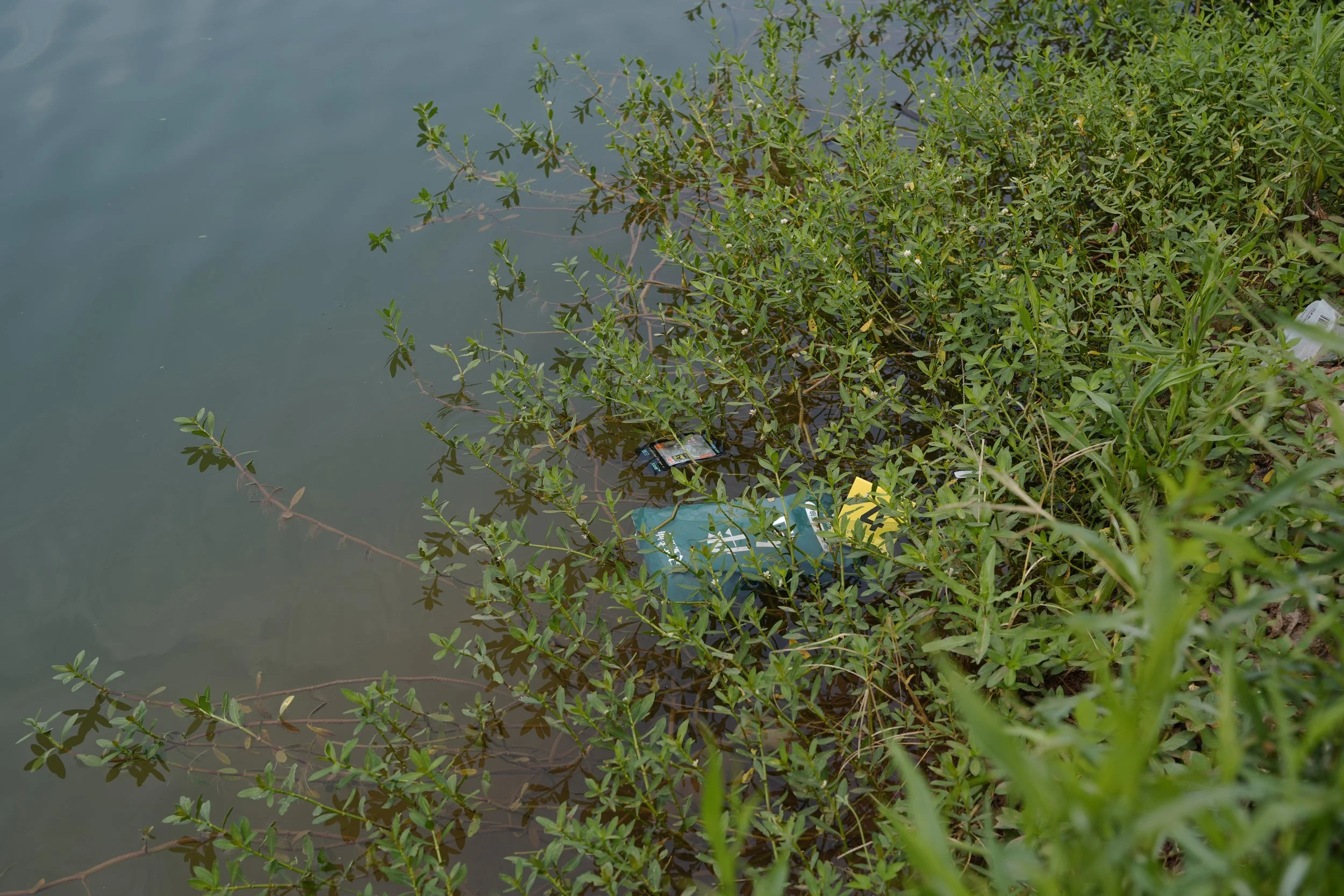
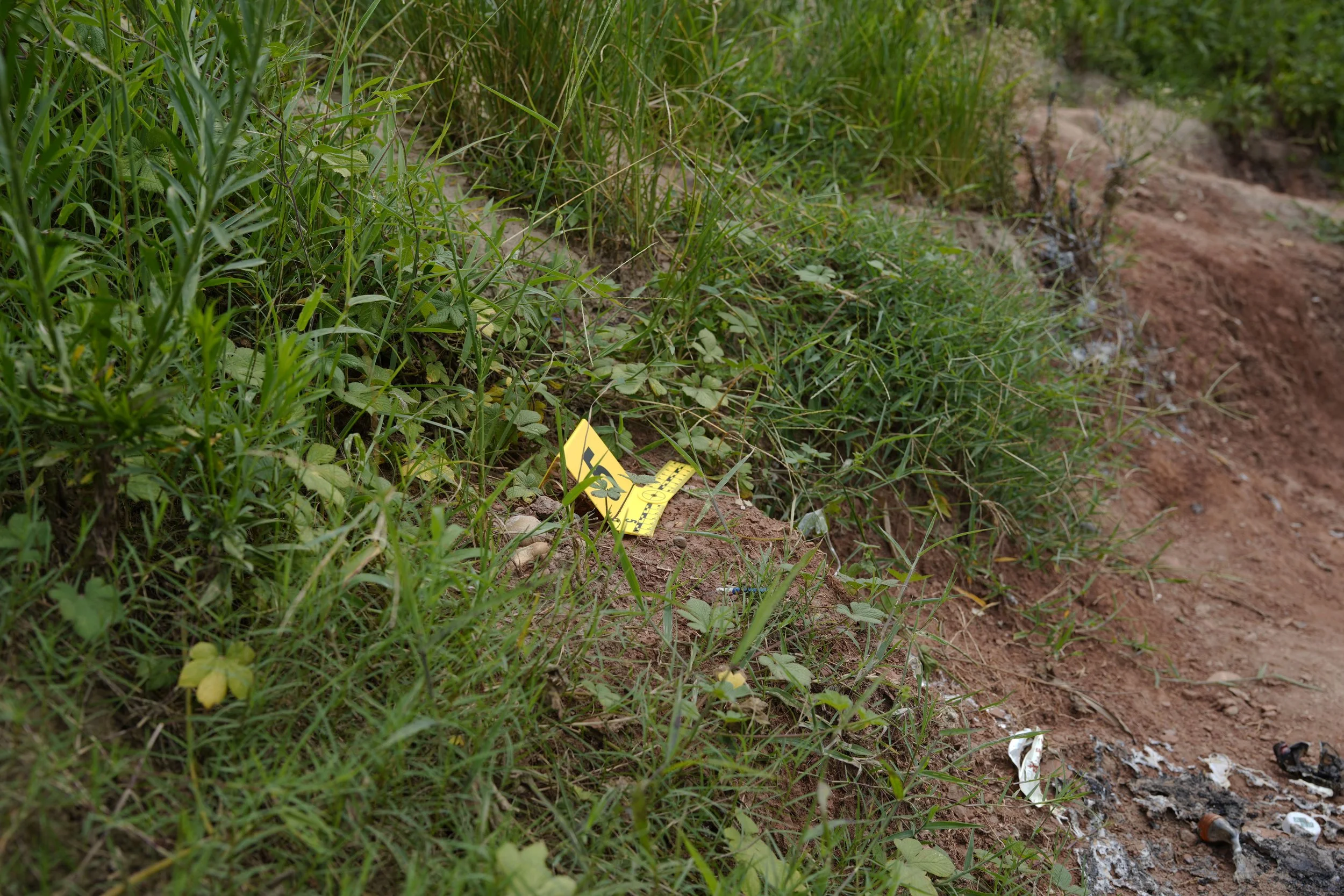
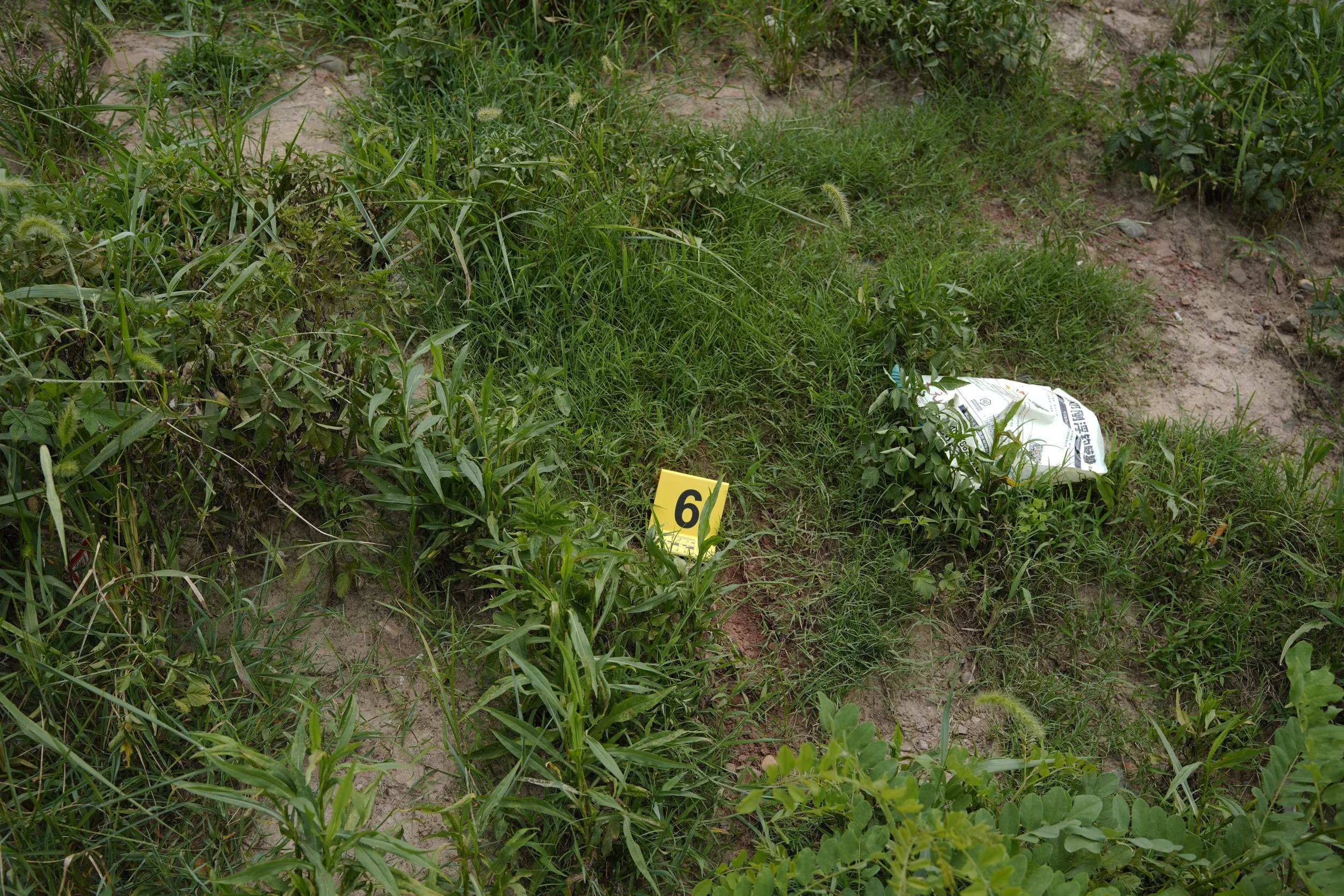
我们前往简阳清风乡黑址湾的小山上,把刻有上述文字的小石碑埋进土里,又在周围放置了一些犯罪现场勘验时所用的数字牌。小山脚下便是村民居所,不知何时会被他们发现,亦不知发现后是否会对相关历史(传说、故事)有讨论。
去到事件发生地附近放置虚假的旧物,我在之前的作品里有过实施。十年创作,每有新的实践,基本上不想复制之前的方法,但对于怎么让具体历史发生场所相对更有效地被重新“激活”的思考确实一直困扰着我(这一点上,我其实并不觉得单纯拍照是可行的)。于我,直至目前,除此之外似乎也没有更合适的办法。
致谢杨昊睿、苏彦霖。
Fu Diji, a Qing dynasty scholar, recorded in his autobiography Chronicle of Mr. Wuma (from the Fu Family Genealogy of the Wuma Bridge Branch):
“In the eighth month of 1644, Zhang Xianzhong captured Chengdu. On the twelfth day of the ninth month, bandits pursued from Hujia Dawan in Renshou, pressing urgently upon over a thousand people from nearby areas. With no choice, they fled up the mountain empty-handed to resist—hence it came to be called ‘Fortress Mountain.’ Shortly after, two cavalrymen ascended the hill. The people scattered, but all were slaughtered at Heizhi Bay, at Xier riverbank. The riverbank and waters were so filled with bodies that not an inch of space remained.”
We traveled to a small hill in Heizhi Bay, Qingfeng Township, Jianyang, and buried a stone tablet engraved with the text above. Around it, we placed forensic evidence markers of the kind used at crime scenes. At the foot of the hill lay village homes—unaware how soon they might discover it, or whether its discovery would stir any discussion of the history (or legends, or stories) connected to this place.
Placing fabricated artifacts near historical sites is something I have done in earlier works. Throughout ten years of artistic practice, I have rarely sought to replicate past approaches. Yet the question of how to more effectively “reactivate” specific historical locations continues to occupy my thoughts (in this regard, I do not consider mere photography a viable path). For me, so far, no more suitable method has emerged.
Acknowledgments: Yang Haorui, Su Yanlin
纪念碑·西洲坝
Monument to Xizhou Sandbar
2025
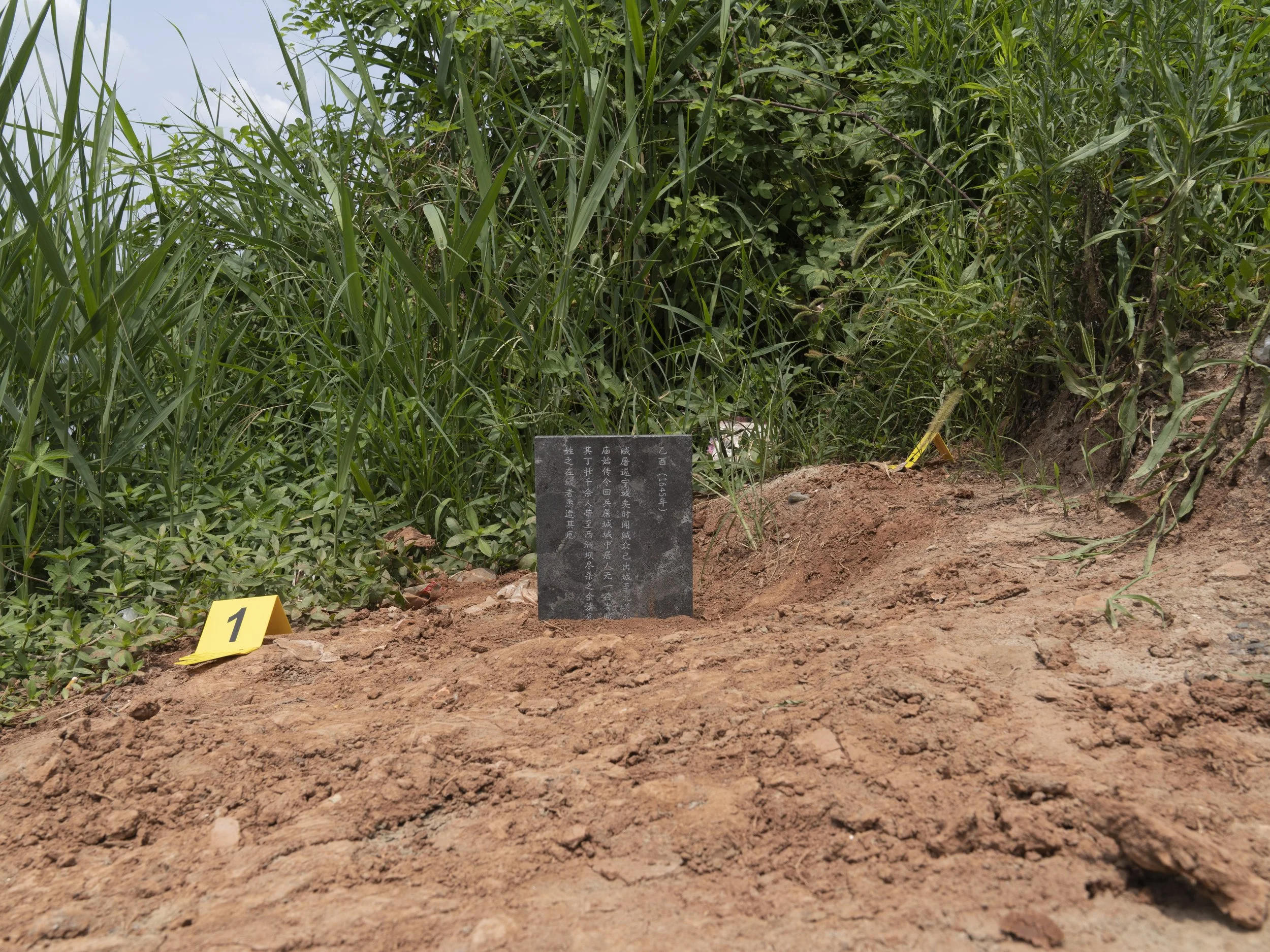
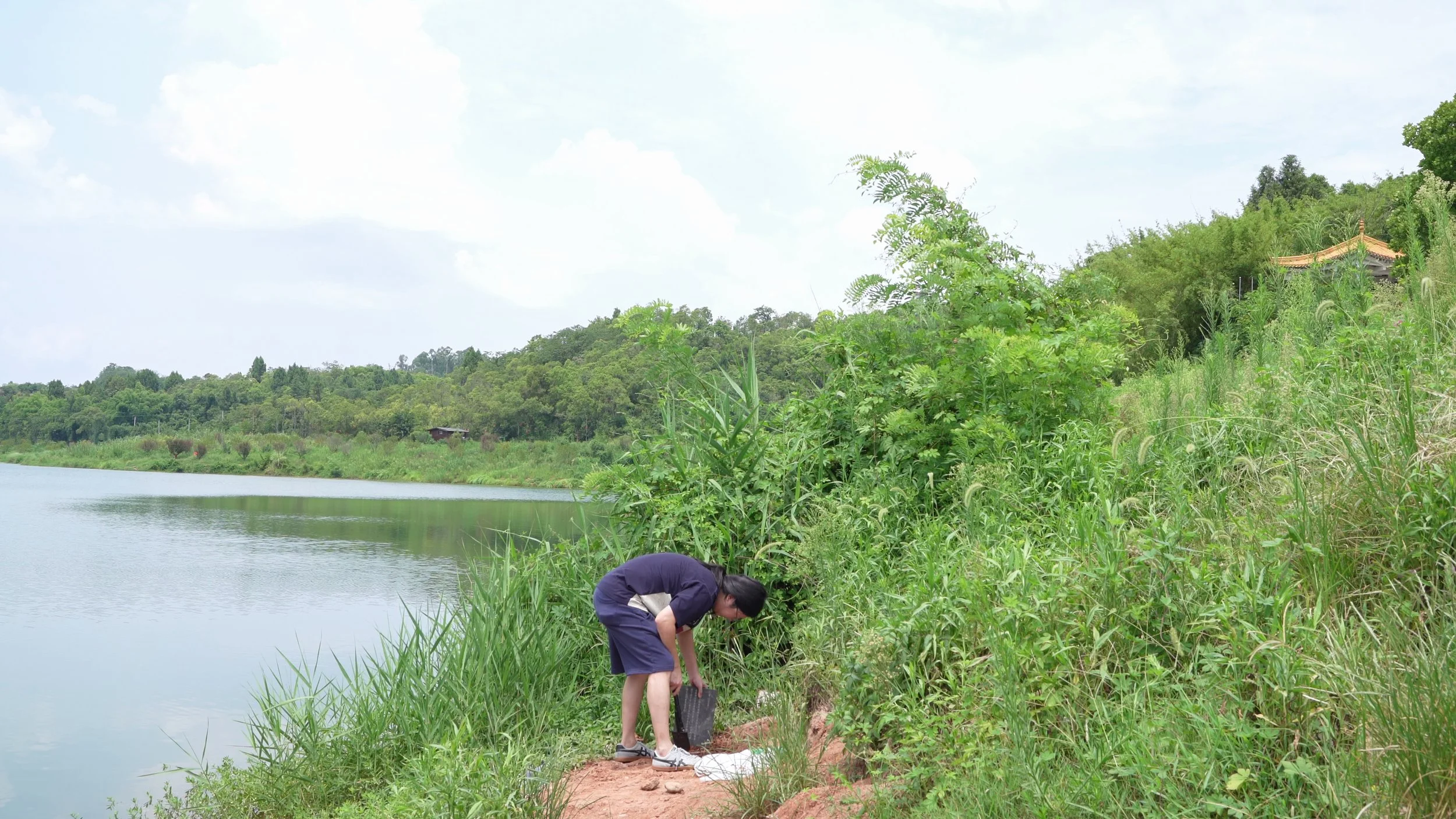
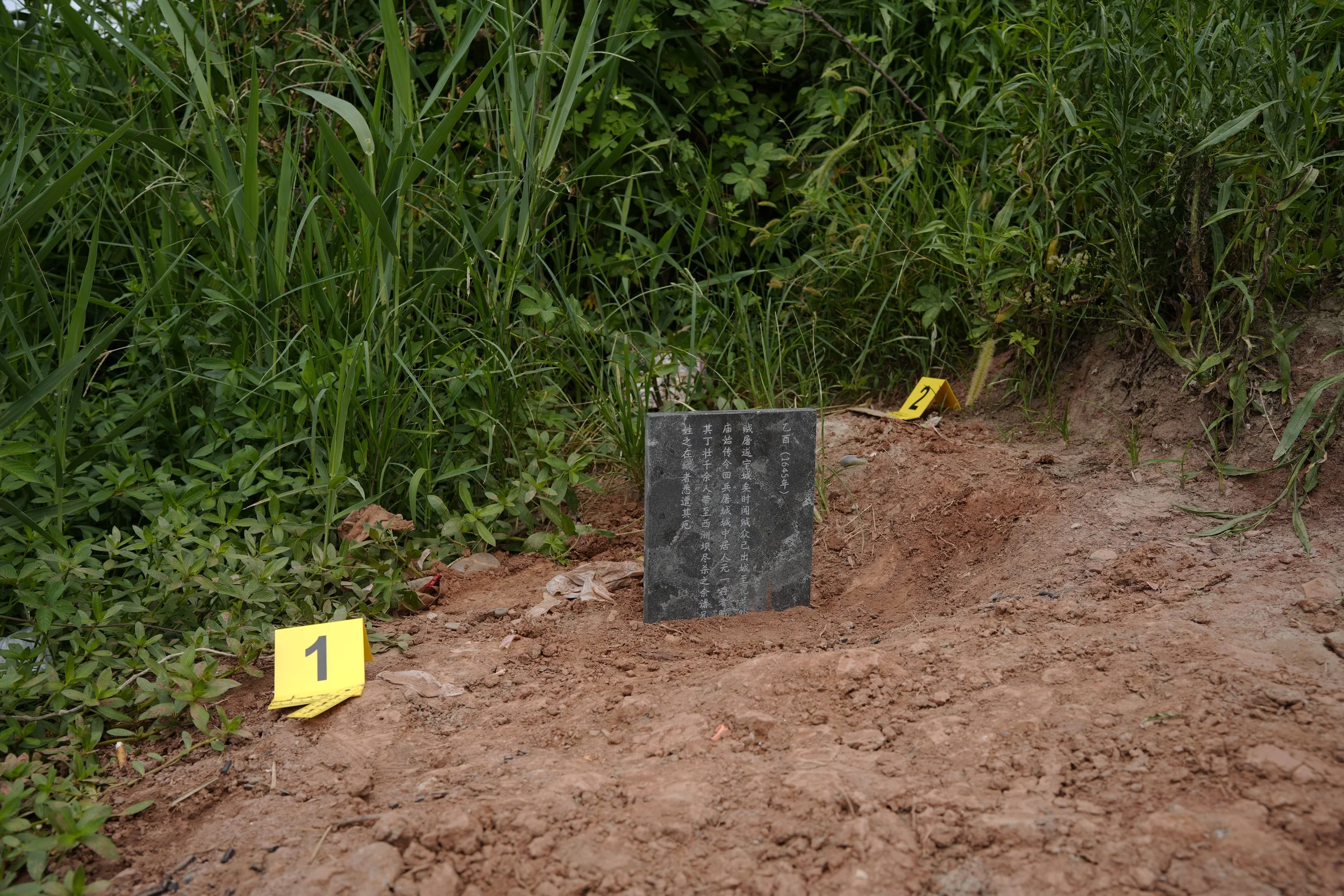
清人张烺在《烬余录》(出自遂宁《张氏族谱》)中记载了张献忠义子孙可望部队屠遂宁事:“乙酉,顺治二年……贼屠遂宁城矣。时闻贼众已出城,至北关外旌忠庙,始传令回兵屠城。城中居人,无一存者。贼又掳其丁壮千余人,带至西洲坝,尽杀之。余诸兄及族姓之在城者,悉遭其厄。”
我们前往原西洲坝的地址——遂宁市船山区城西广德寺(唐代已降的著名观音道场)附近,把刻有上述文字的小石碑埋进土里,又在周围放置了一些犯罪现场勘验时所用的数字牌。不知何时会被附近的人发现,亦不知发现后是否会对相关历史(传说、故事)有讨论。
这是继简阳清风乡黑痣湾后第二个埋小石碑的地方。
致谢吴梓维。
Zhang Lang, a scholar of the Qing dynasty, recorded in his account Records of the Ashes (included in the Suining Zhang Family Genealogy) the massacre of Suining by the troops of Sun Kewang, a adopted son of the rebel leader Zhang Xianzhong:
“In the year 1645, the second year of the Shunzhi reign… the bandits massacred Suining. It was said that the rebels had already left the city and reached the Jingzhong Temple outside the northern gate, when the order was given to turn back and slaughter the city. Not a single resident in the city survived. The bandits also captured over a thousand able-bodied men, took them to Xizhou Sandbar, and killed them all. My elder brothers and all our clansmen who were in the city fell victim to this calamity.”
We traveled to the historical site of Xizhou Sandbar—near the Guangde Temple in the western part of Chuanshan District, Suining City, a renowned site of Avalokitesvara worship since the Tang Dynasty—and buried a small stone tablet engraved with the text above. Around it, we placed forensic evidence markers of the kind used at crime scenes. It remains unknown when it will be discovered by people nearby, or whether its discovery will stir any discussion of the related history, legends, or stories.
This site serves as the second location for burying such a tablet, following the one in Heizhi Bay, Qingfeng Township, Jianyang.
Acknowledgment: Wu Ziwei
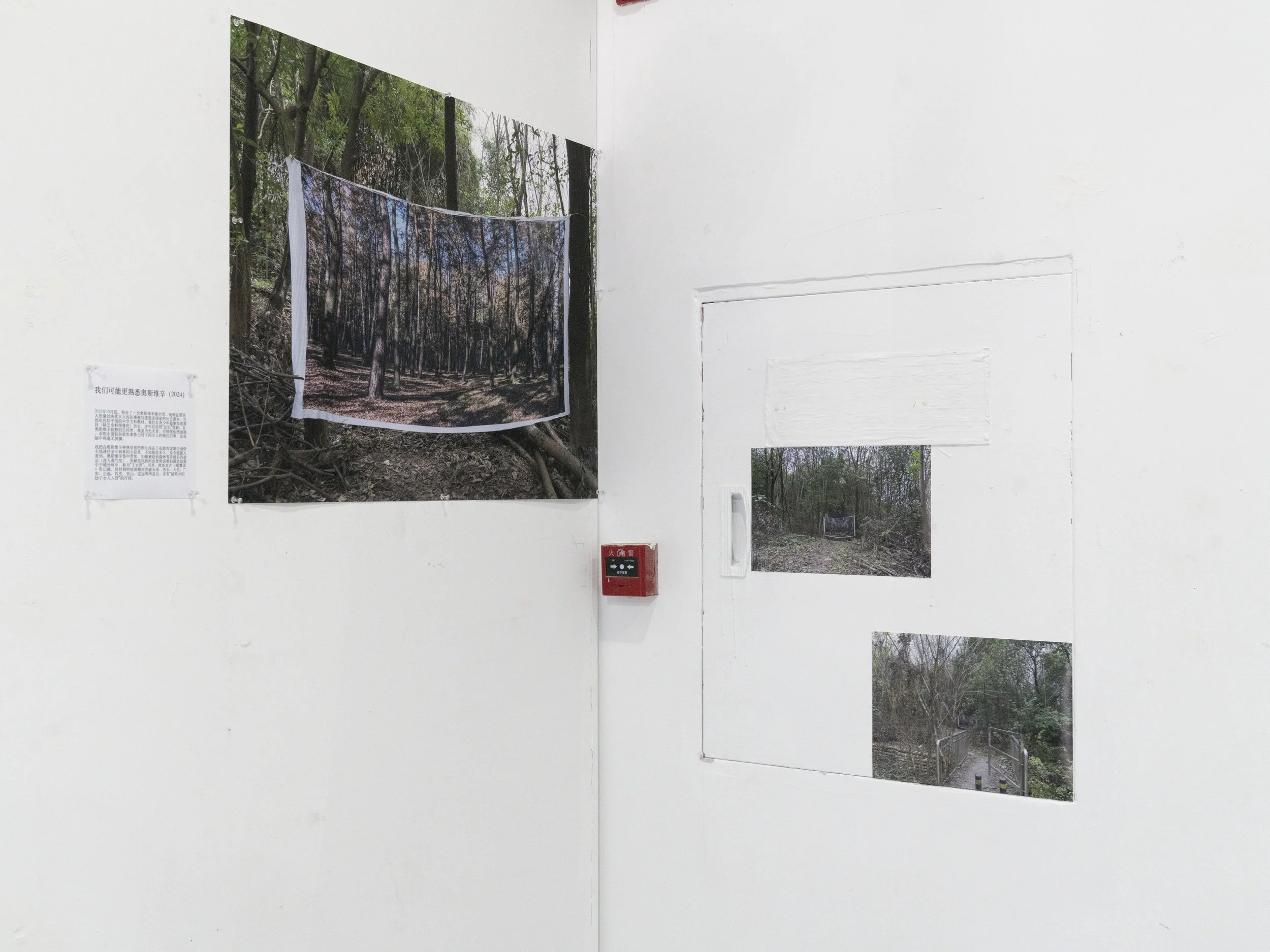
我们可能更熟悉奥斯维辛
We Might be More Familiar with Auschwitz
2024
2022年10月底,我去了一次奥斯维辛集中营,纳粹在那里大批量处决犹太人的往事被写进很多国家的历史课本,当然也包括中国的中学文科教材。我们自青少年起便知道那段(缺乏史料图像的)历史,多年后依然“记忆”犹新。在奥斯维辛寂静的空间里,我虽为无关者,但情绪依然汹涌。而明末清初各股军事势力对于四川人的镇压旧事,在我脑中则毫无波澜。
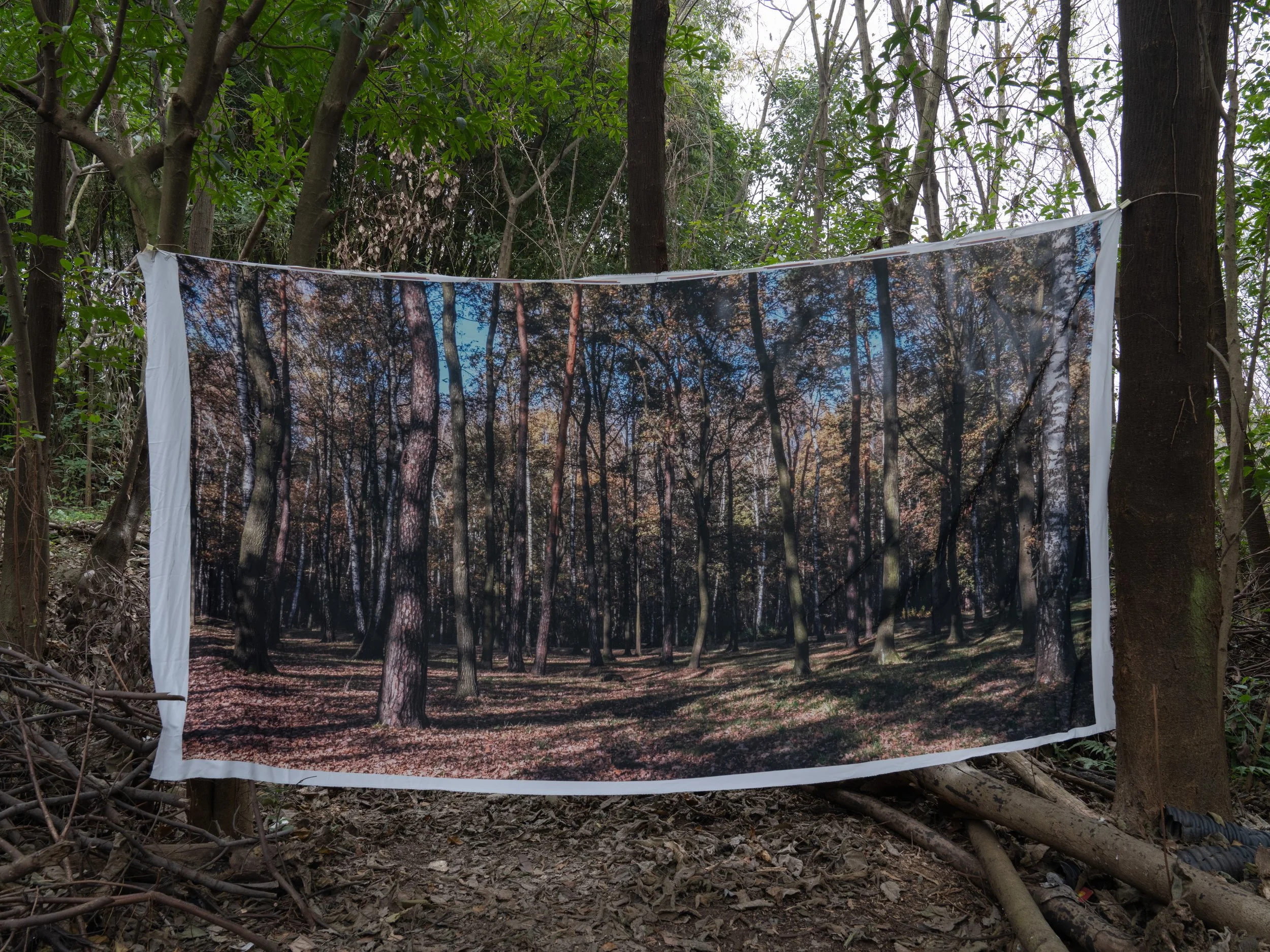
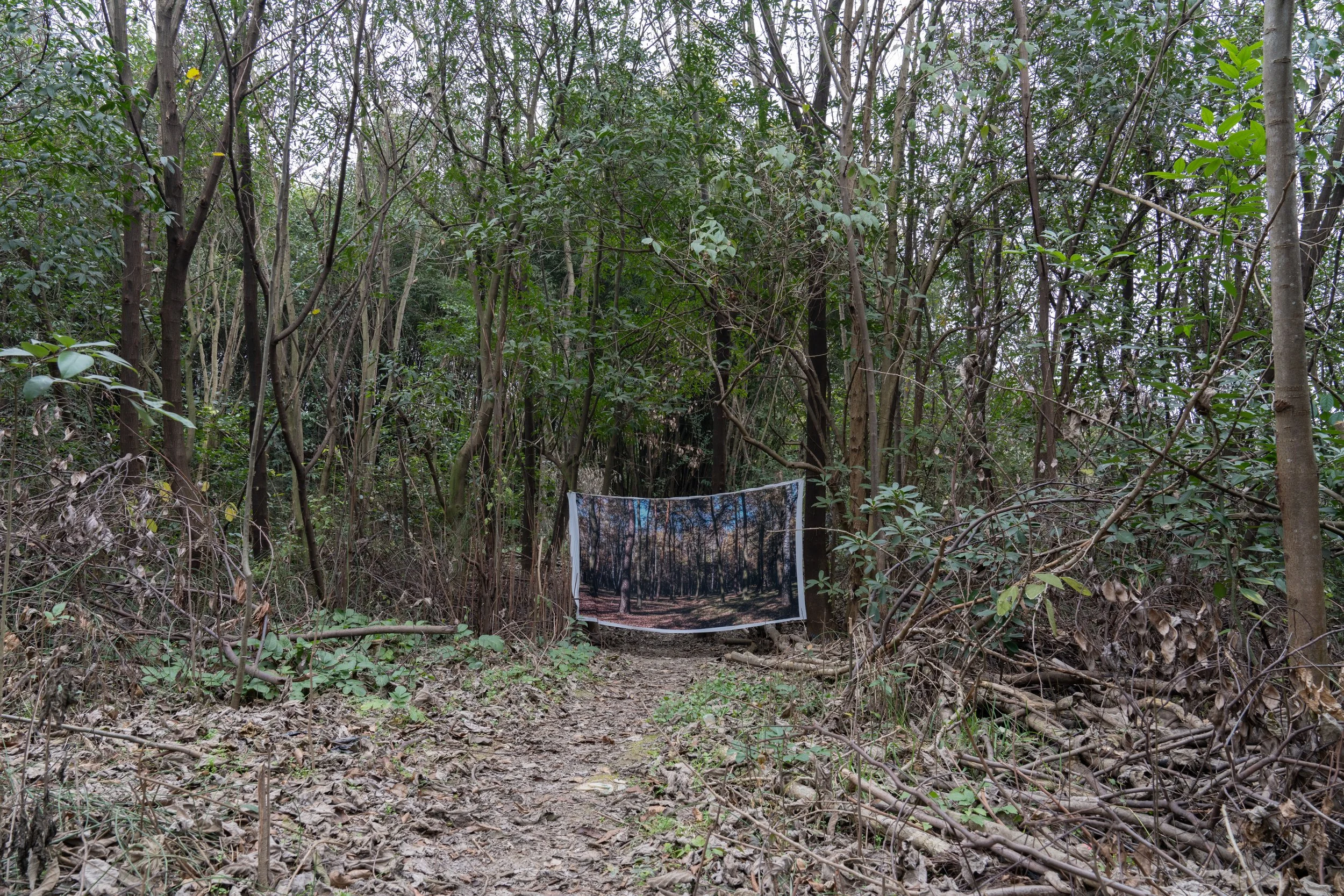
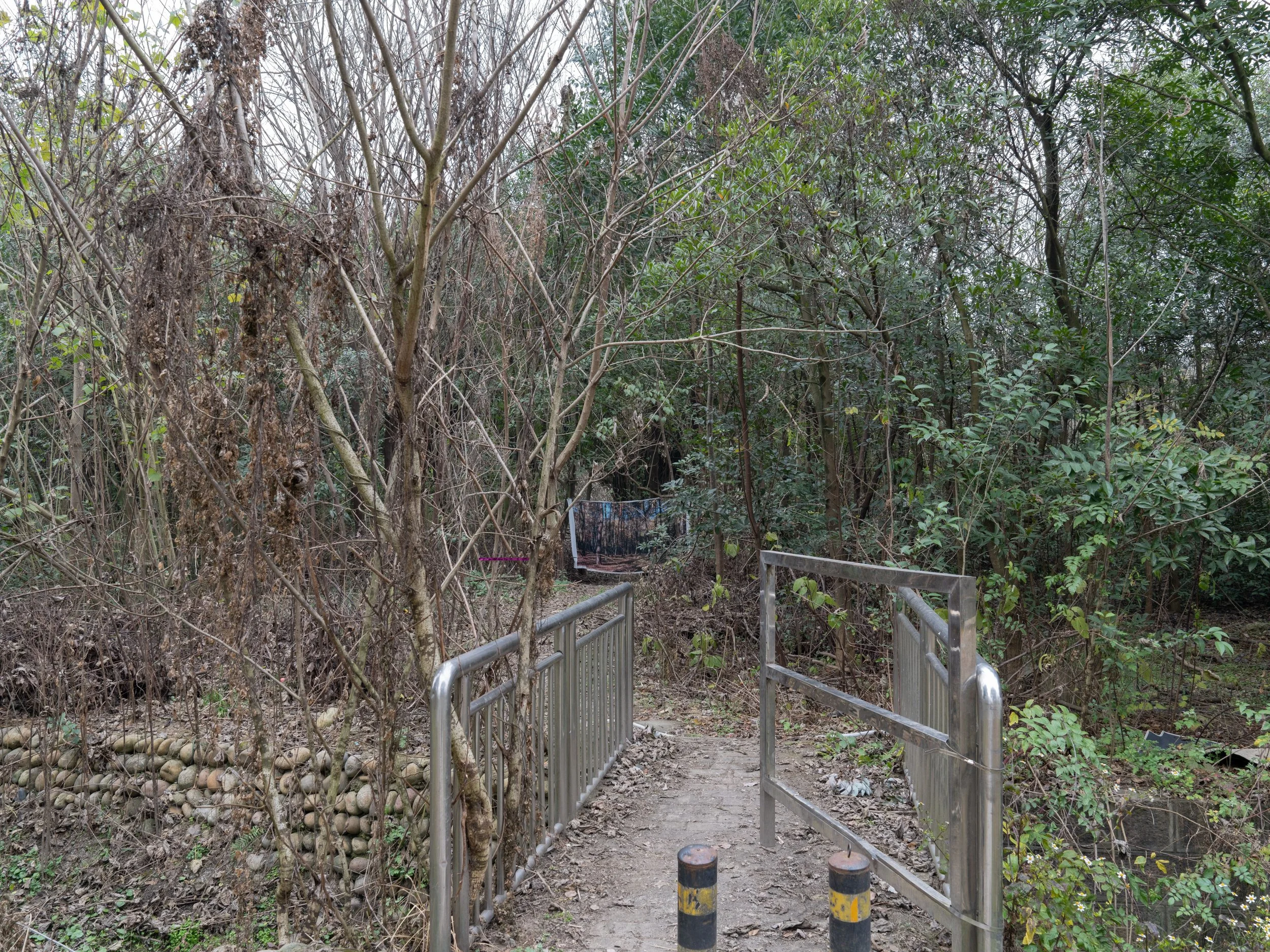
我把在奥斯维辛树林里拍的照片挂在了成都青龙湖公园停车场通往某片树林的小径里,不知能挂多久,是否能被人看到。奥斯维辛集中营里,妇孺被赶到森林等待最后的命运(进入毒气室),张献忠执政时也曾将成都妇孺老幼集中于城外林中,称为“子女营”。另外,欧阳直在《蜀警录》里记载,同时期的摇黄贼在攻破长寿、邻水、大竹、广安、岳池、西充、营山、定远等州县后,亦有“掳其少妇幼子女人入营”的行径。
In late October 2022, I visited the Auschwitz concentration camp. The history of the Nazis' mass execution of Jews there has been written into the history textbooks of many countries, including, of course, the humanities curriculum in Chinese middle schools. Since our youth, we have been aware of that history—despite the lack of historical visual materials—and years later, it remains “vivid” in our memory. In the silent spaces of Auschwitz, though I was an unrelated outsider, my emotions surged intensely. In contrast, the historical suppressions of Sichuan people by various military forces in the late Ming and early Qing dynasties stirred no ripples in my mind.
I hung a photo I took in the woods of Auschwitz along a path leading to a grove in the Chengdu Qinglong Lake Park parking lot, unsure how long it would remain or whether anyone would see it. In Auschwitz, women and children were herded into the forests to await their final fate—entry into the gas chambers. Similarly, when Zhang Xianzhong held power, he gathered Chengdu's women, children, and elderly in forests outside the city, calling them the “Children's Camps.” Additionally, Ouyang Zhi recorded in the Shu Jing Lu that during the same period, the Yao-Huang rebels, after capturing counties such as Changshou, Linshui, Dazhu, Guang'an, Yuechi, Xichong, Yingshan, and Dingyuan, also committed acts of “seizing young women and children into their camps.
恩情
A Debt of Gratitude
2026
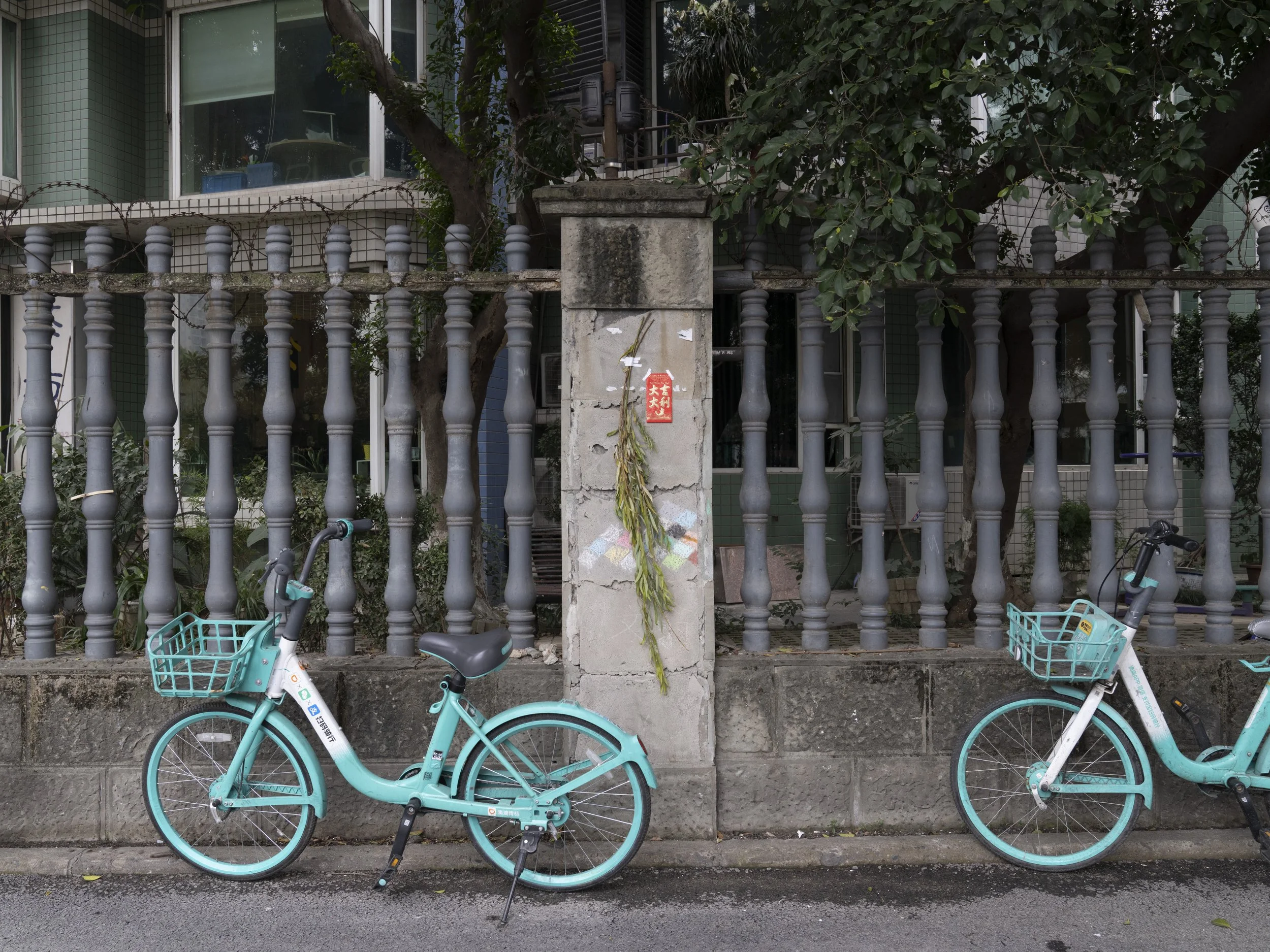
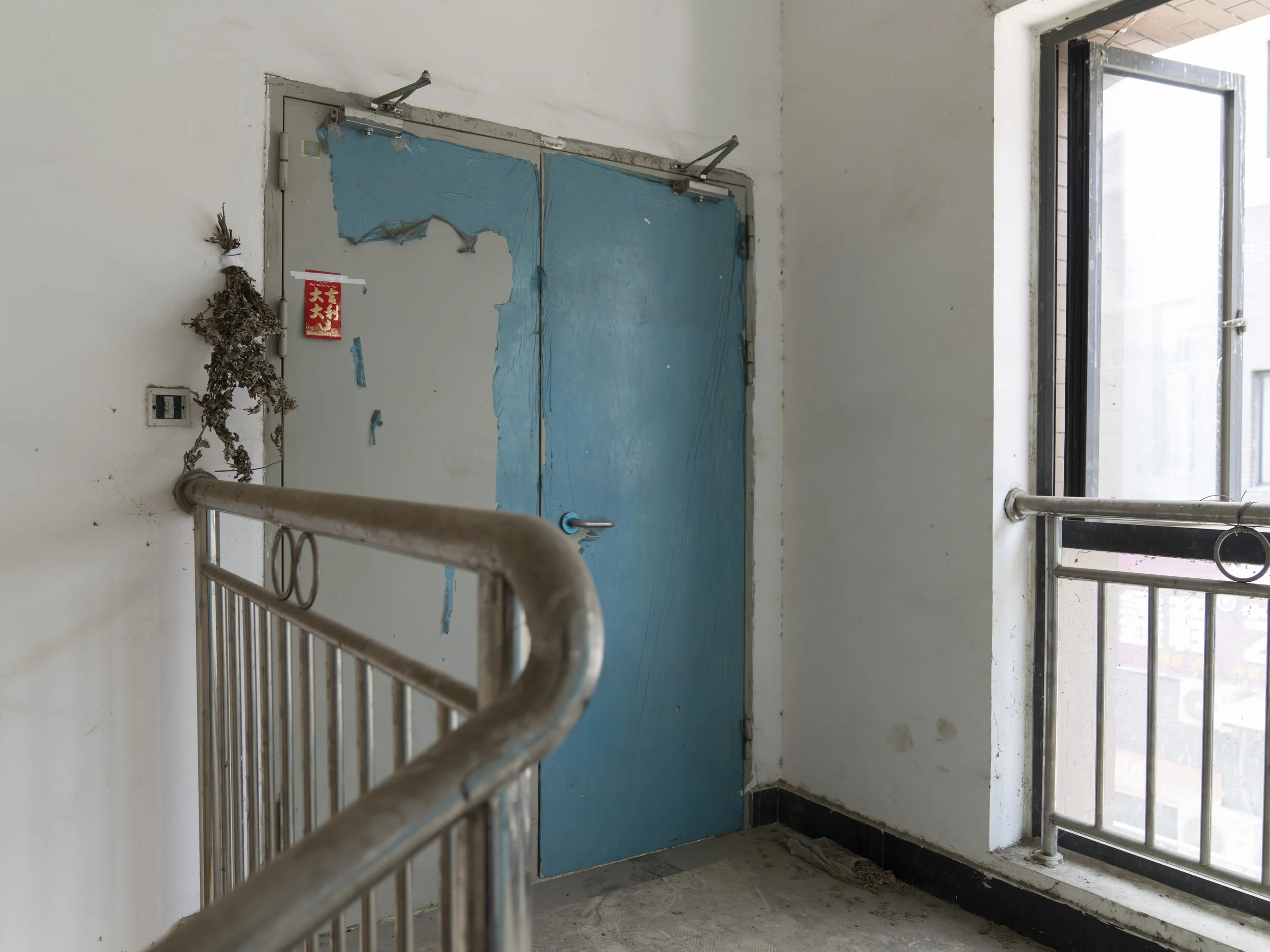
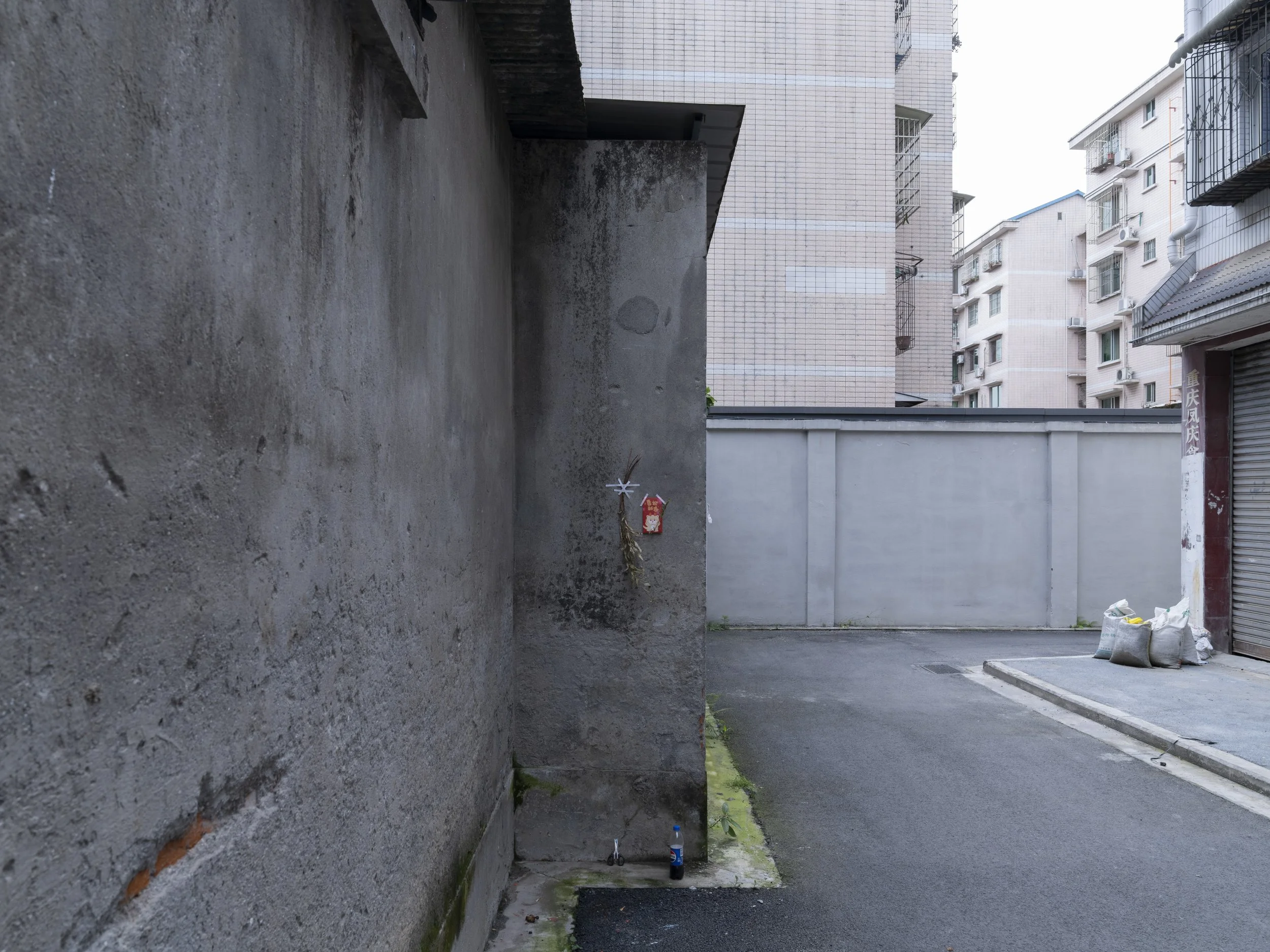
川渝境内一些地方的民间故事里,存在着挂某种植物的枝条便不会被义军掠杀的内容。不同版本的具体物件有异(如插柳条、艾蒿、菖蒲,甚至旗帜等),但梗概相似:张献忠带领兵士行进时,遇一妇人,背着一幼童,另一幼童在其身后跟着(或牵着跑)。问其缘由,妇人曰背的是他人子女,跑着的是自己的孩子。自己的孩子如有不测还能再生一个,故更要保全好他人子嗣。献忠敬之,便令其回家,在门口插上某物,兵士凡见此物,不得入内杀剐。
这些叙事模板能追溯西汉刘向所著的《列女传》中《节义传·鲁义姑姊》。
我把与某些地点涉及故事相关的植物枝条置于该地墙面,附以6元红包,待某位幸运儿收取,祝愿TA幸福安康。
致谢占涛、彭宇轩、吴梓维、朱本正、郭云天。
In folk tales from certain regions of Sichuan and Chongqing, there are stories suggesting that hanging branches of certain plants would protect people from being killed by rebel forces. While the specific objects vary across different versions (such as willow twigs, mugwort, calamus, or even flags), the general plot remains similar: As Zhang Xianzhong led his troops on a march, he encountered a woman carrying a young child on her back, with another young child following behind her (or running alongside her). When asked why, the woman explained that the child on her back belonged to someone else, while the one running was her own. She explained that while she could have another child of her own if anything happened to him, it was all the more important to protect the children of others. Impressed by her devotion, Zhang Xianzhong allowed her to return home and instructed her to place a specific object at her doorstep; any soldier who saw this object was forbidden from entering to kill or maim.
These narrative templates can be traced back to Biographies of Exemplary Women (Lie Nü Zhuan), written by the 1st-century BCE Chinese literary figure Liu Xiang during the Western Han Dynasty.
I placed branches from plants associated with the stories of certain locations on the walls of those sites, attaching a 6-yuan red envelope to each, waiting for a lucky person to take it, and wishing them happiness and good health.
Special thanks to Zhan Tao, Peng Yuxuan, Wu Ziwei, Zhu Benzheng, and Guo Yuntian.
(可能)听见了
(Perhaps,) They Heard It
2025
成都万里桥(今南门大桥)。
清人沈荀蔚《蜀难叙略》载:“南门外万里桥为屠戮之所。”又有佚名者《蜀记》载:“……齐出南门外江边……每贼一人,引妇女数百,至江边驱令自跳。号哭之声,闻数十里。”
我将一些电影里的谋杀、抛尸入水的声音在南门桥旁高音量功放,每段声音间隔2分钟。其间,少有路人对声音作出反应。
这一行为致谢杨昊睿、苏彦霖。
Wanli Bridge, Chengdu (present-day South Gate Bridge).
Shen Xunwei's A Brief Account of the Calamities in Sichuan from the Qing Dynasty records: "Wanli Bridge outside the southern gate was a site of massacre." Additionally, an anonymous text, Records of Sichuan, states: "... they were herded out to the riverbank outside the southern gate... For each bandit, hundreds of women were led to the river's edge and forced to jump in. The sound of their wailing could be heard for tens of li."
I amplified audio clips from films depicting murder and the disposal of bodies in water, playing them at high volume next to South Gate Bridge. Each clip was separated by two minutes of silence. Few passersby reacted to the sounds.
This act acknowledges with thanks Yang Haorui and Su Yanlin.
医者针砭
The Physician’s Needle
2025
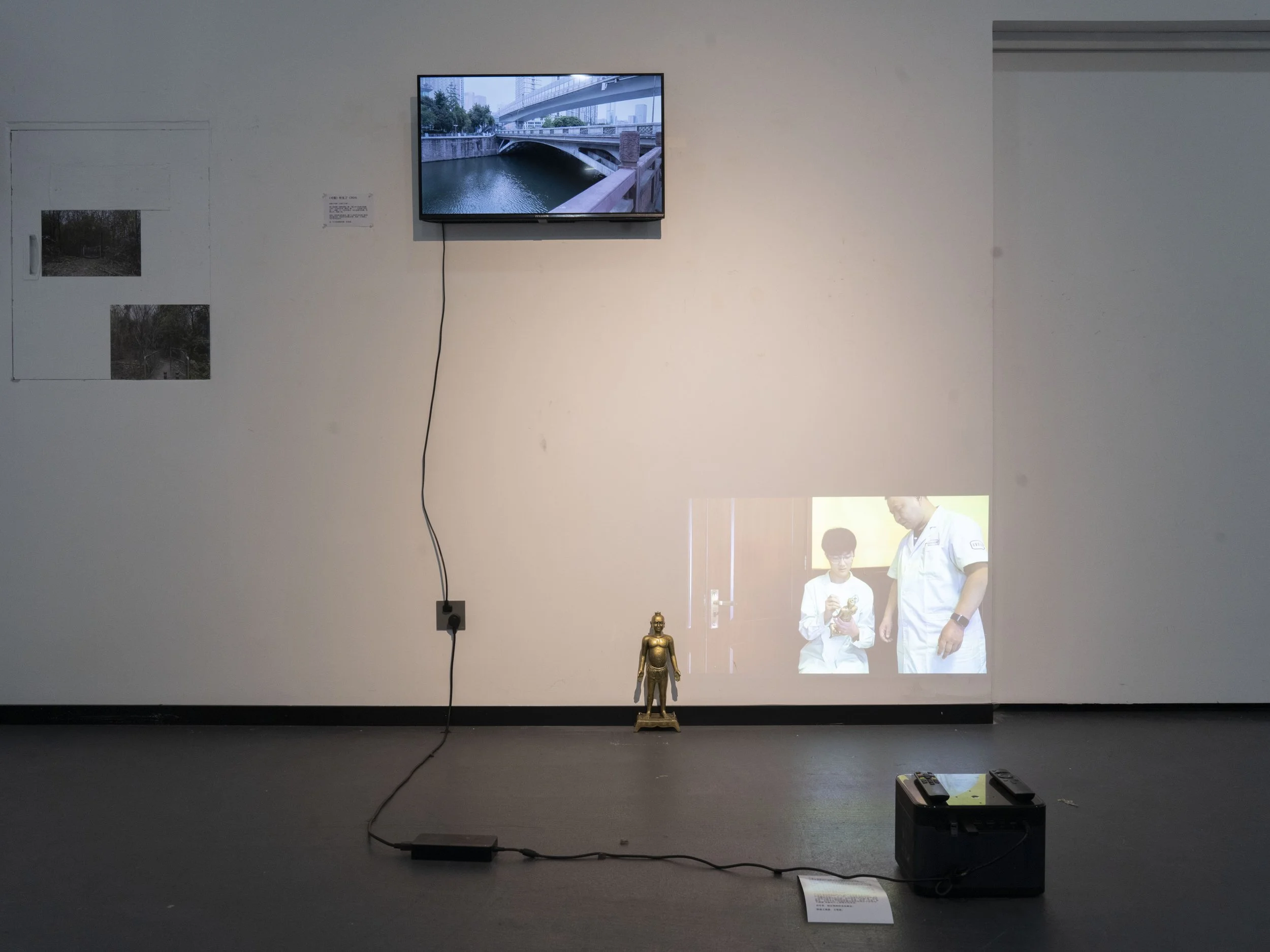
清代四川戏曲理论家、诗人李调元在《井蛙杂记》里写道:“蜀府医院有铜人,以楮幕其窍,令医者针之,差者即取金枪刺医者窍。”此事在俞忠良的《流贼张献忠祸蜀记》等野史文献中亦有记载:“出铜人,伪验医者针砭,差一穴者立死。”
2025年7月,我与学生王博豪及其父王雪坡(中医工作者)模拟了这一情景(或者说其一半的规则)。我在线上远程念出一个个穴位名,王父于其工作处指导王博豪扎针于铜人身上的对应位置。念穴位的速度逐渐加快,最后终止于“命门穴”。
过程中,王父似乎倾向于帮助王博豪“完成”每一次扎针,并尽量向他介绍念到的穴位的功能和扎针要领。过度阐述一下,作为医者的王父可能下意识代入了自己日常工作中与学生、后辈或者患者的交流状态。这也致使我念穴位的速度没有预想中快(规则被实时情况压制,想要礼貌地等王父介绍完再进行下一个)。我觉得这同时反映了“游戏”预设的紧迫性远远低于几百年前被记载的往事——完不成“游戏”的惩罚,也仅仅是对那往事一瞬间的想象。
所以此游戏再次回应了《坏在张献忠拿荨麻擦了……》这个系列实践的“不可能”:不可能关联起记忆(记忆本就不存在),不(太)可能激发起对于彼时威迫、残酷的诸事件的共情。但在这些“不可能”里,也存在着可以被当下感知的共性。毕竟,游戏(作业)要做完。王同学也不知道屏幕对面的老师会不会因为“不满意”而做出什么情理外的举动。
再毕竟,制定规则的是张献忠。
致谢王博豪、王雪坡。
Li Diaoyuan, an opera theorist and poet of the Qing dynasty, wrote in his Jotted Notes of a Frog in a Well:
“In the hospital of Sichuan, there stood bronze figures. Their acupoints were covered with paper, and physicians were ordered to needle them through the covering. Any who missed the mark would immediately be pierced in their own acupoints with a metal spear.”
This account is also found in unofficial histories such as Yu Zhongliang’s Record of the Rebel Zhang Xianzhong’s Devastation of Sichuan:
“Some bronze figures were brought out to test the physicians’ needling. Missing a single acupoint meant instant execution.”
In July 2025, together with student Wang Bohao and his father, Wang Xuepo (a practitioner of traditional Chinese medicine), we reenacted this scenario—or rather, half of its rules. Remotely, via an online call, I called out the names of acupoints one by one. Mr. Wang, from his workplace, guided his son to insert needle into the corresponding positions on a bronze figure. The pace of the recitation gradually accelerated, finally concluding at the “Gate of Life” (命门穴) acupoint.
During the process, Mr. Wang seemed inclined to assist Bohao in “completing” each needling, taking the opportunity to explain the functions of each acupoint and the essentials of the technique. To overinterpret slightly, the physician father may have subconsciously slipped into the mode of communication he uses daily with students, juniors, or patients. This, in turn, prevented my recitation from reaching the initially imagined speed—the rules were subdued by the real-time situation, as I felt compelled to politely wait for Mr. Wang’s explanations before proceeding. This also reflects, I think, that the presumed urgency of our “game” was far lower than that of the event recorded centuries ago. The penalty for failing to complete the “game” was merely a fleeting imagination of that past.
Thus, this exercise once again echoes the “impossibility” central to the artistic practice of It Got Messed up 'Cause Zhang Xianzhong Wiped His… with Nettle: the impossibility of connecting with memory (which does not exist to begin with), and the difficulty (if not impossibility) of evoking empathy for the cruelty of those bygone events. Yet, within these “impossibilities,” there also exist commonalities perceptible in the present. After all, the game (the task) had to be completed. And student Wang could not know whether the teacher on the other side of the screen might, out of “dissatisfaction,” do something unexpected.
Then again, the one who originally set the rules was Zhang Xianzhong.
儿戏
Child's Play
2024-2025
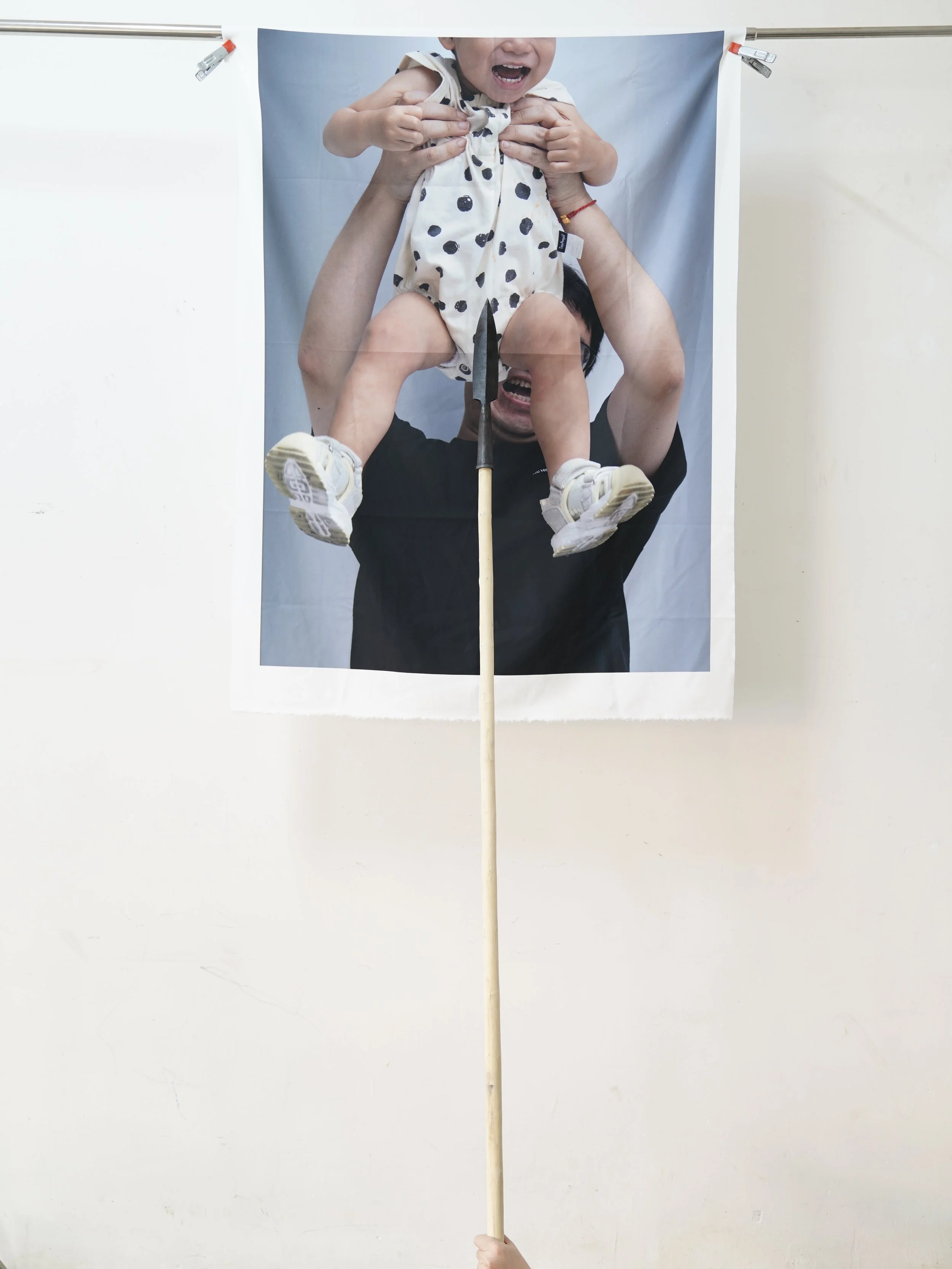
欧阳直在《蜀警录》中描述明末蜀地的摇黄贼屠戮川民的可怖行径:“每以小儿抛空中,下用长枪刃接儿……如此惨虐,殆又甚于献贼矣。” 当下的我们是否需要对这些暴行代入具体的情绪?我不知道。我请一位父亲抱起他的孩子上下轻抛,在他表达宠与爱的过程里,我始终没有告知他如此做是在复刻什么。
致谢普耘、刘文斌、吴梓维。
Ouyang Zhi recorded the horrors perpetrated by the Yao-Huang bandits in late Ming Sichuan in his book Shu Jing Lu: "They would often toss infants into the air and catch them upon the points of their spears... Such cruelty was perhaps even more extreme than that of Zhang Xianzhong." Do we, today, need to attach specific emotions to these atrocities? I do not know. I asked a father to gently toss his child up and down in play. Throughout this expression of affection and love, I never told him that his actions mirrored those of the past.
Acknowledgments: Pu Yun, Liu Wenbin and Wu Ziwei.
自思自量
Ponder and Weigh Your Own Deeds
2025
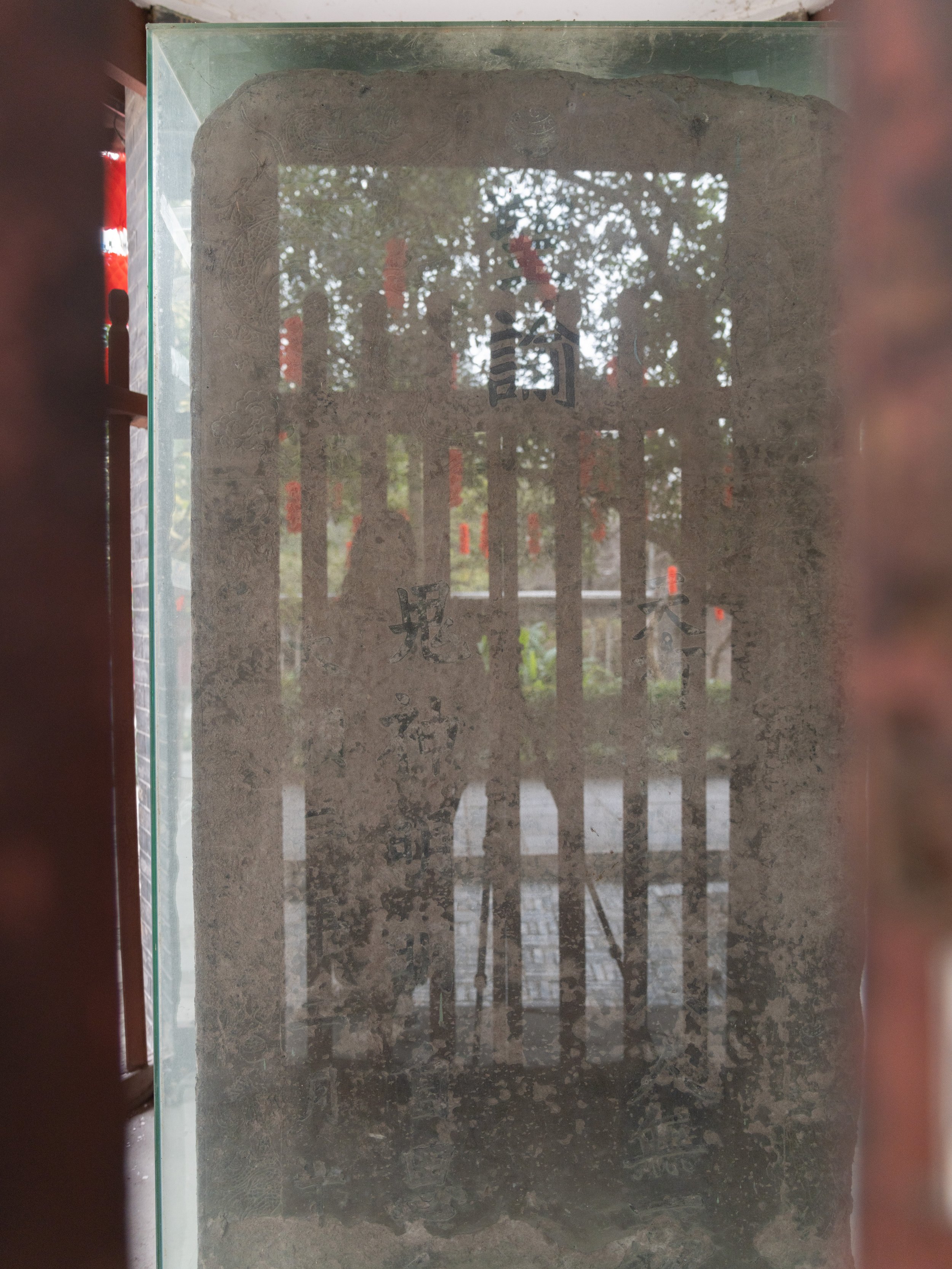
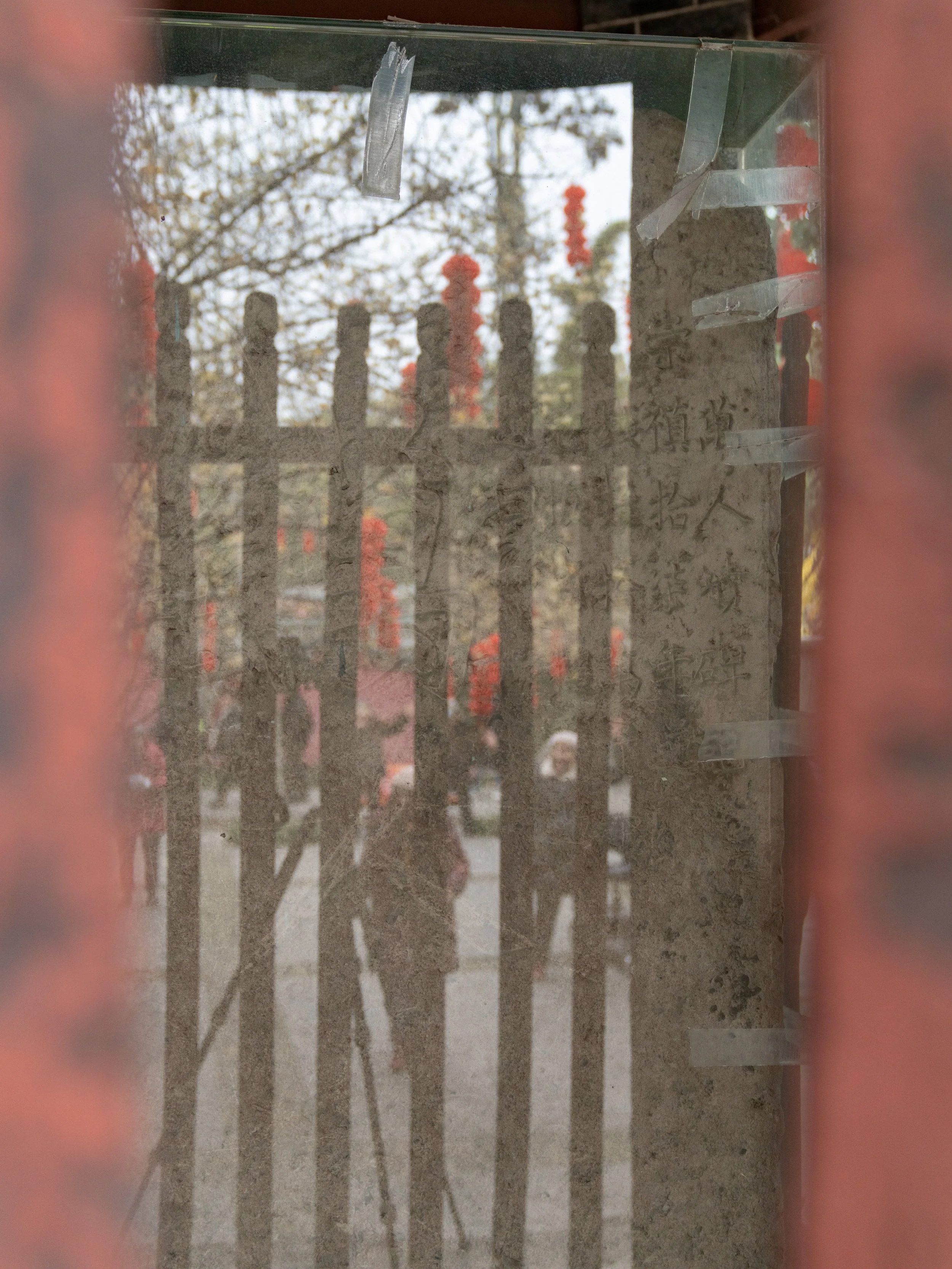
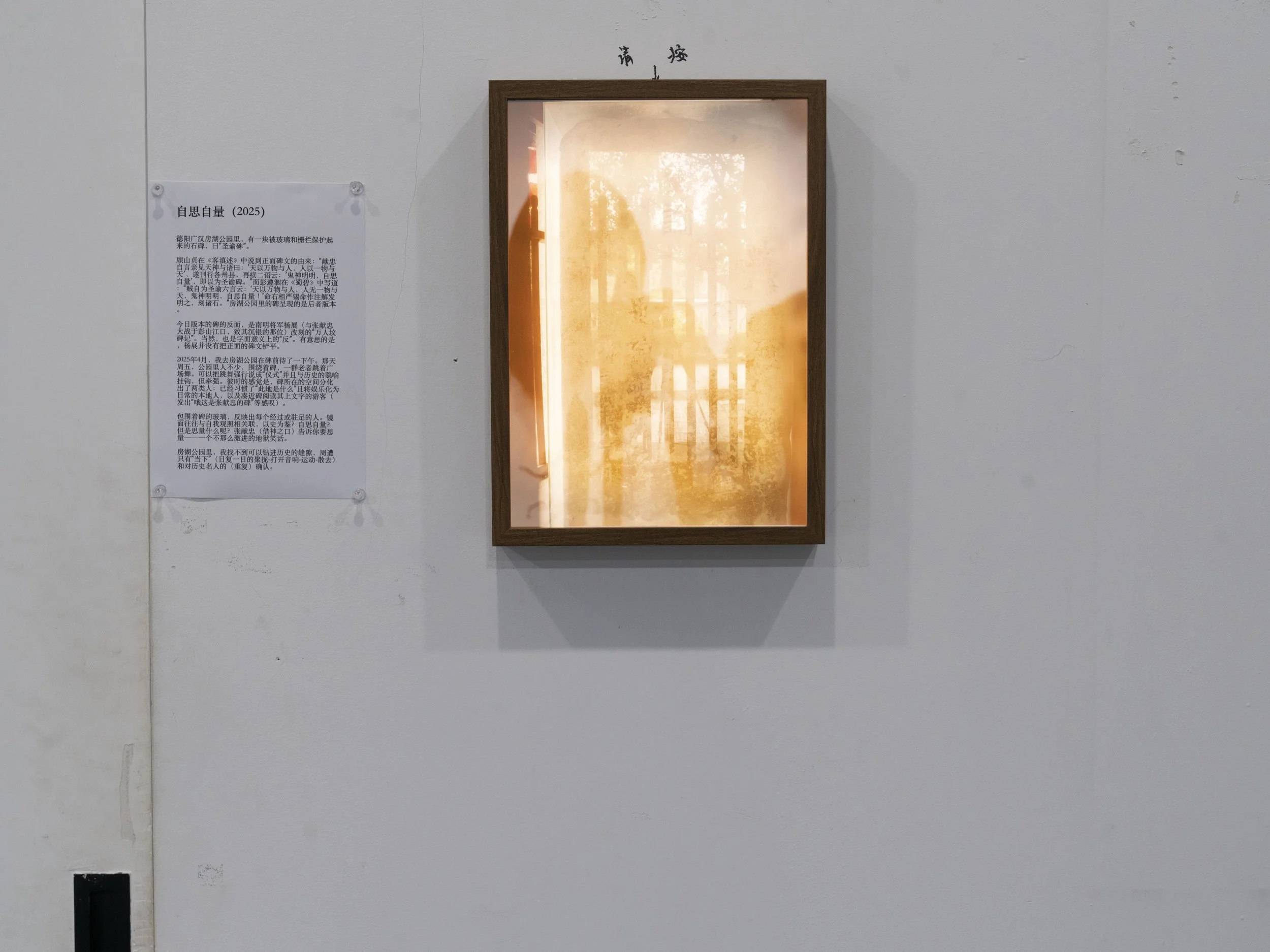
德阳广汉房湖公园里,有一块被玻璃和栅栏保护起来的石碑,曰“圣谕碑”。
顾山贞在《客滇述》中说到正面碑文的由来:“献忠自言亲见天神与语曰:’天以万物与人,人以一物与天’,遂刊行各州县,再续二语云:’鬼神明明,自思自量’,即以为圣谕碑。”而彭遵泗在《蜀碧》中写道:“贼自为圣谕六言云:‘天以万物与人,人无一物与天,鬼神明明,自思自量!’命右相严锡命作注解发明之,刻诸石。”房湖公园里的碑呈现的是后者版本。
今日版本的碑的反面,是南明将军杨展(与张献忠大战于彭山江口,致其沉银的那位)改刻的“万人坟碑记”。当然,也是字面意义上的“反”。有意思的是,杨展并没有把正面的碑文铲平。
2025年4月,我去房湖公园在碑前待了一下午。那天周五,公园里人不少,围绕着碑,一群老者跳着广场舞。可以把跳舞强行说成“仪式”并且与历史的隐喻挂钩,但牵强。彼时的感觉是,碑所在的空间分化出了两类人:已经习惯了“此地是什么”且将娱乐化为日常的本地人,以及凑近碑阅读其上文字的游客(发出“哦这是张献忠的碑”等感叹)。
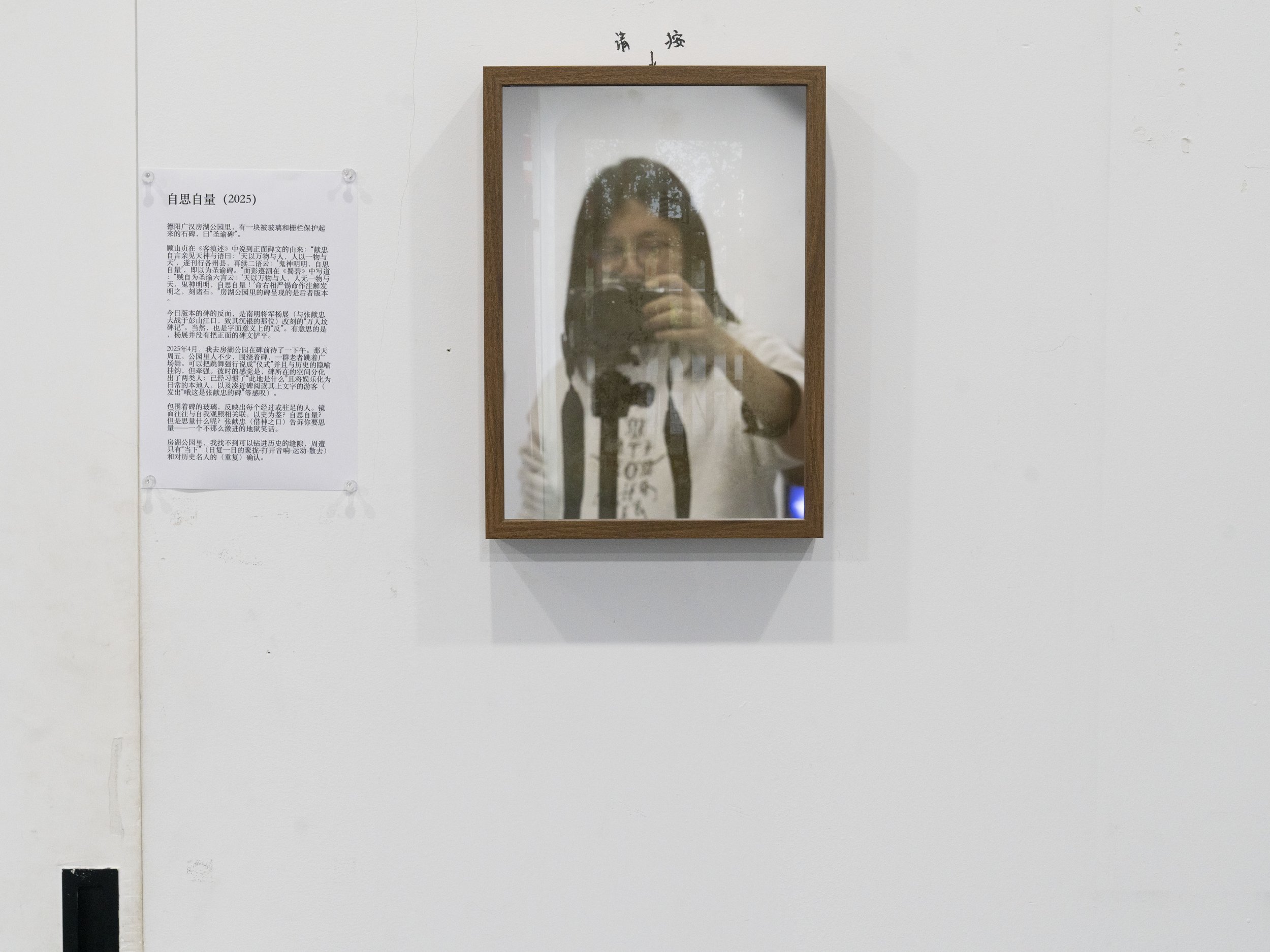
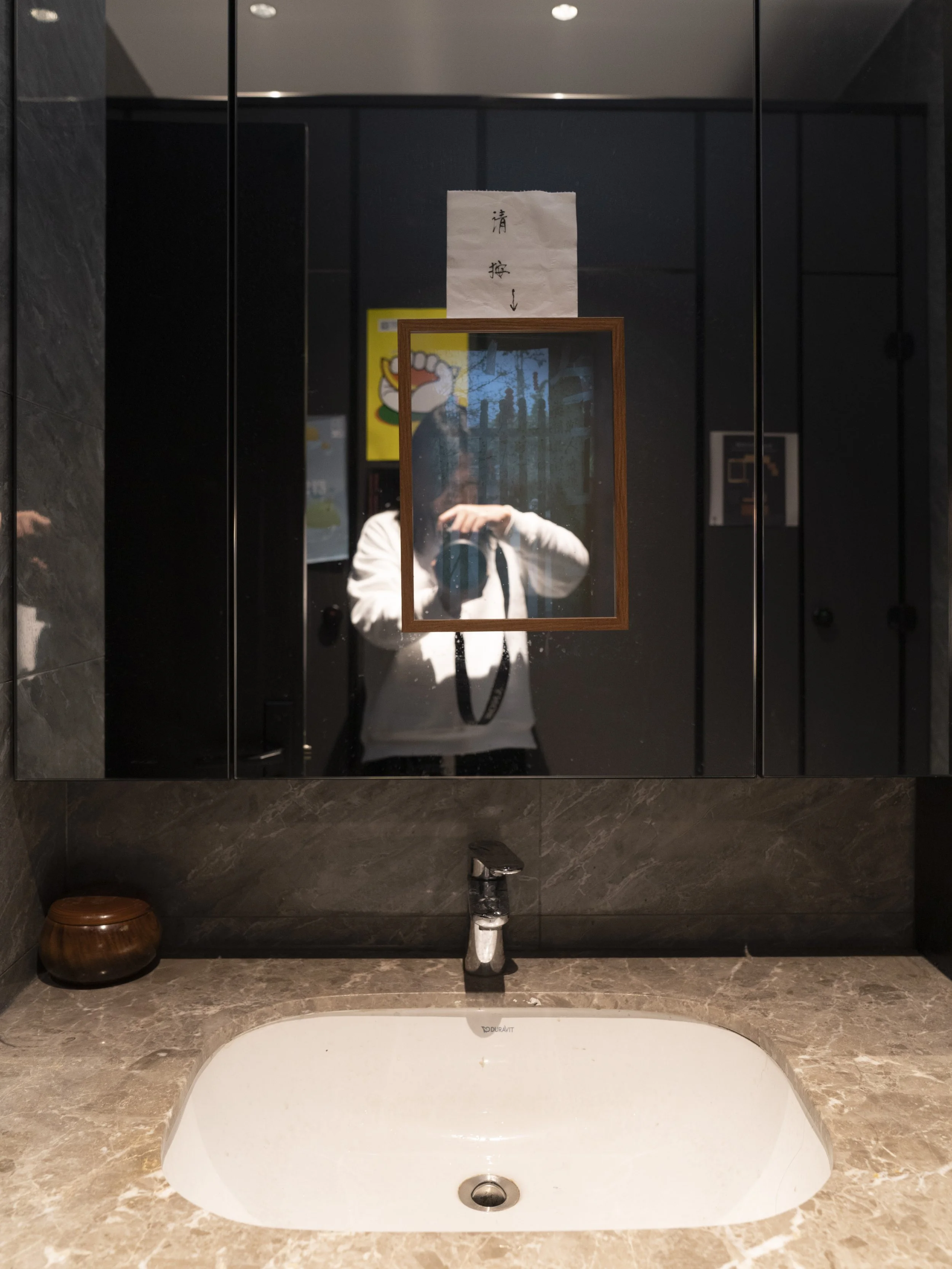
包围着碑的玻璃,反映出每个经过或驻足的人。镜面往往与自我观照相关联,以史为鉴?自思自量?但是思量什么呢?张献忠(借神之口)告诉你要思量——一个不那么激进的地狱笑话。
房湖公园里,我找不到可以钻进历史的缝隙,周遭只有“当下”(日复一日的聚拢-打开音响-运动-散去)和对历史名人的(重复)确认。
In Fanghu Park, Guanghan, Deyang, there stands a stone stele protected by glass and railings, known as the “Sacred Edict Stele.”
Gu Shanzhen, in his An Account of a Sojourn in Yunnan, wrote of the origin of the front inscription: “Zhang Xianzhong claimed to have seen and spoken with a heavenly deity, who told him, ‘Heaven gives all things to humanity, humanity gives one thing back to Heaven.’ He then ordered this to be promulgated across all prefectures and counties, later adding two more lines: ‘Spirits and gods see all. Ponder and weigh your own deeds.’ This became the Sacred Edict Stele.” Peng Zunsi, however, recorded in The Green of Sichuan: “The rebel himself composed a six-line sacred edict: ‘Heaven gives all things to humanity, humanity gives nothing back to Heaven. Spirits and gods see all. Ponder and weigh your own deeds!’ He ordered his Right Chancellor Yan Ximing to annotate and explicate it, and had it carved onto stone.” The stele in Fanghu Park displays the latter version.
On the reverse side of the stele’s present-day version is an inscription re-carved by Yang Zhan, a Southern Ming general (known for battling Zhang Xianzhong at Jiangkou in Pengshan, resulting in the sinking of Zhang’s treasure)—the “Record of the Mass Grave.” Of course, it is also literally on the opposite side. Interestingly, Yang Zhan did not erase the text on the front.
In April 2025, I went to Fanghu Park and stayed in front of the stele for an entire afternoon. It was a Friday; the park was crowded. Surrounding the stele, a group of elderly people danced to music. One could forcibly label their dancing as a “ritual” and link it to historical metaphors, but that would be a stretch. At that moment, the space around the stele seemed to divide people into two types: the locals, who had grown accustomed to “what this place is” and integrated recreation into their daily lives, and the tourists, who leaned in to read the inscription, uttering remarks like, “Oh, this is Zhang Xianzhong’s stele.”
The glass enclosing the stele reflected everyone who passed by or paused. Mirrors are often associated with self-contemplation. Using history as a mirror? Ponder and weigh? But ponder what? Zhang Xianzhong (speaking through a deity) tells you to reflect—a rather radical kind of hellish joke.
In Fanghu Park, I could find no crack to slip through into history. All around was only the “present”—the daily routine of gathering, turning on the music, exercising, and dispersing—and the (repeated) acknowledgment of historical figures.
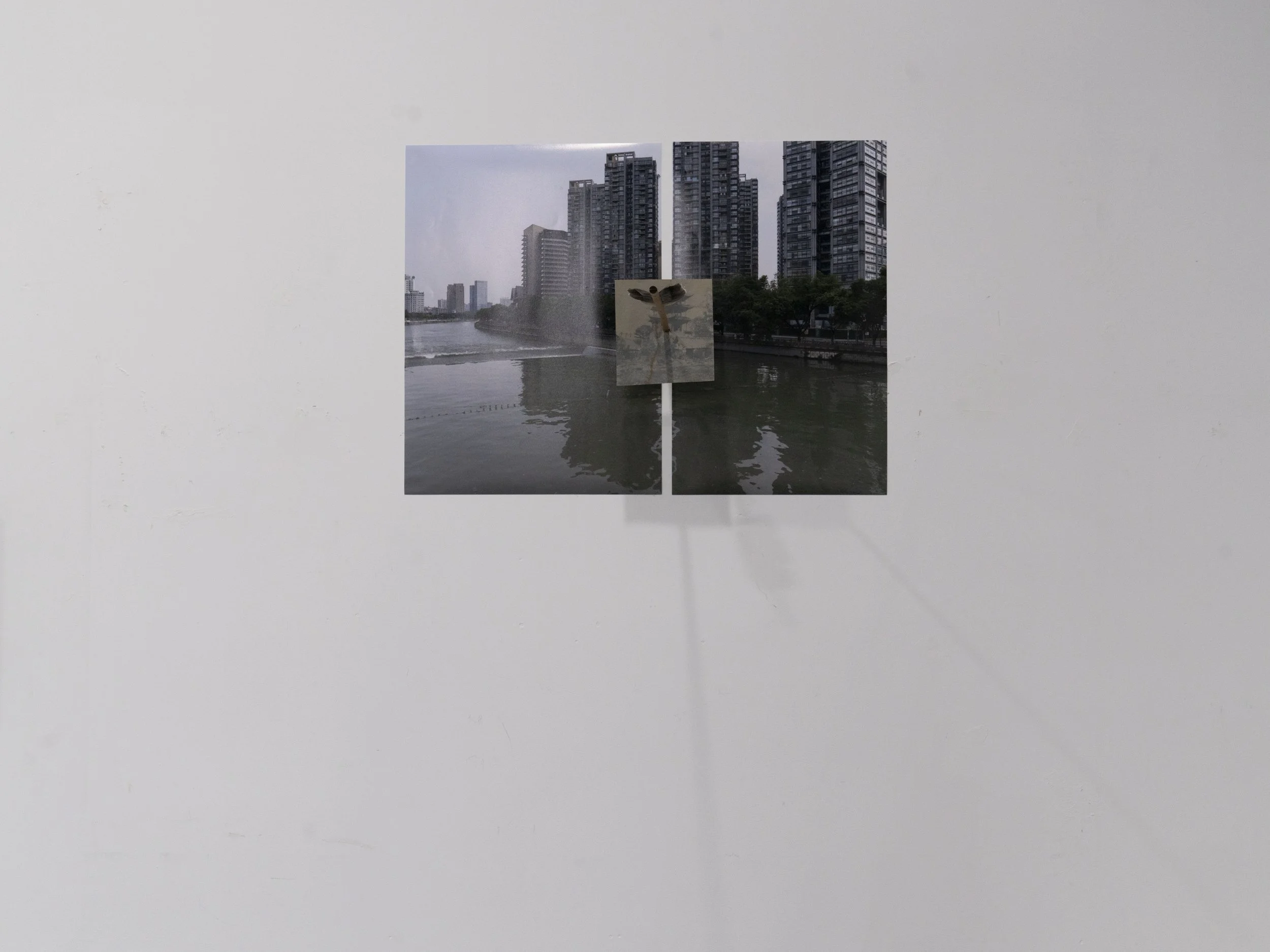
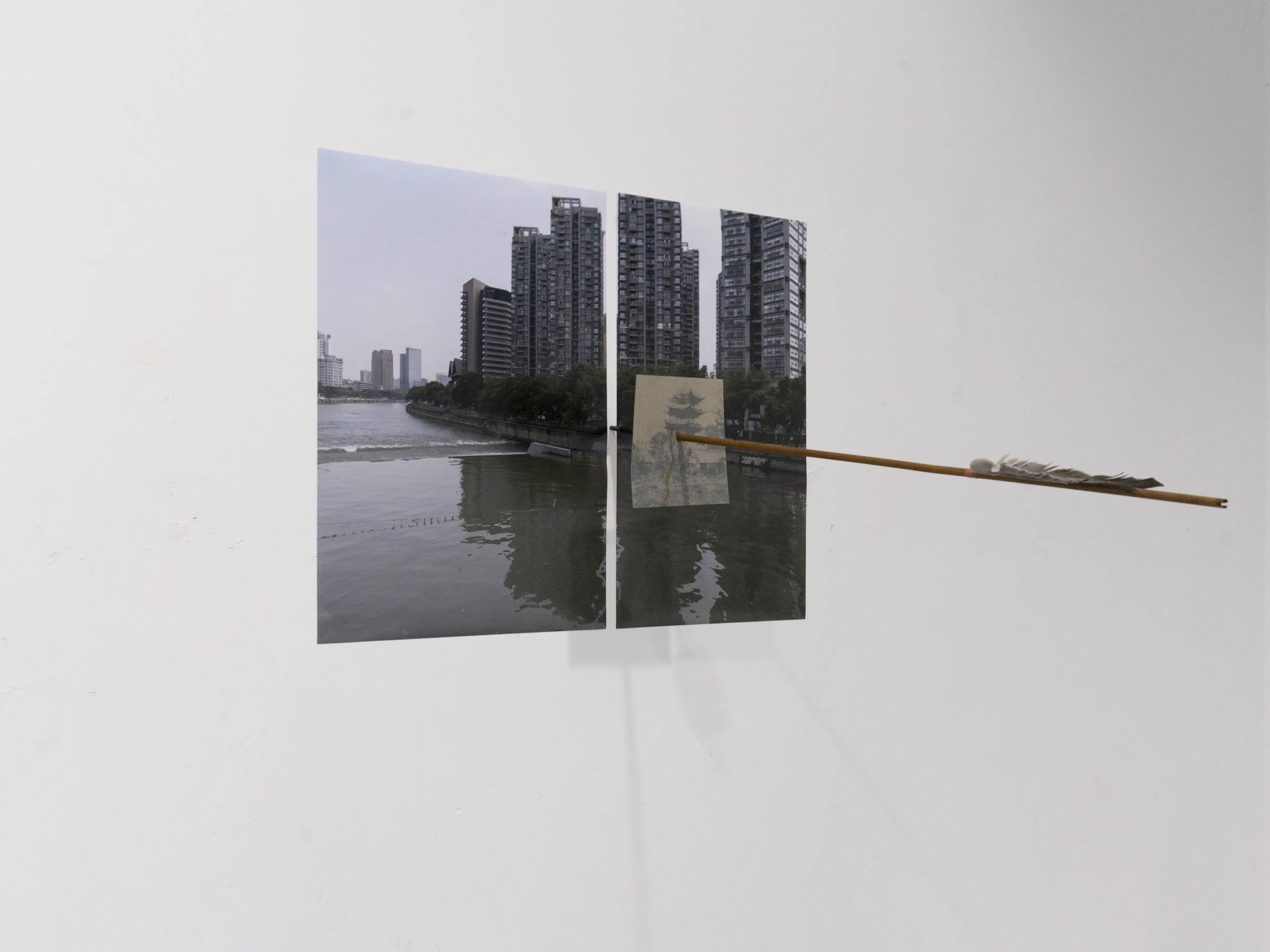
诸葛亮的预言(从九眼桥望向白塔寺)
Zhuge Liang's Prophecy
(Viewing White Pagoda Temple from the Jiuyan Bridge)
2025
“修塔余一龙,拆塔张献忠。
岁逢甲乙丙,此地血流红。
妖运终川北,毒气播川东。
吹箫不用竹,一箭贯当胸。”
To build the Pagoda, Yu Yilong by name;
To tear it down, Zhang Xianzhong came.
When years of Jia, Yi, Bing in cycle start,
This land will bleed, its lifeblood made to part.
An ill fate ends where Northern rivers flow;
A poisoned breath through Eastern lands will blow.
Not bamboo – the flute through which death's note is cast.
One arrow shall pierce through his heart at last.
可他没有杀我们
Yet He Did Not Kill Us
2024-2025
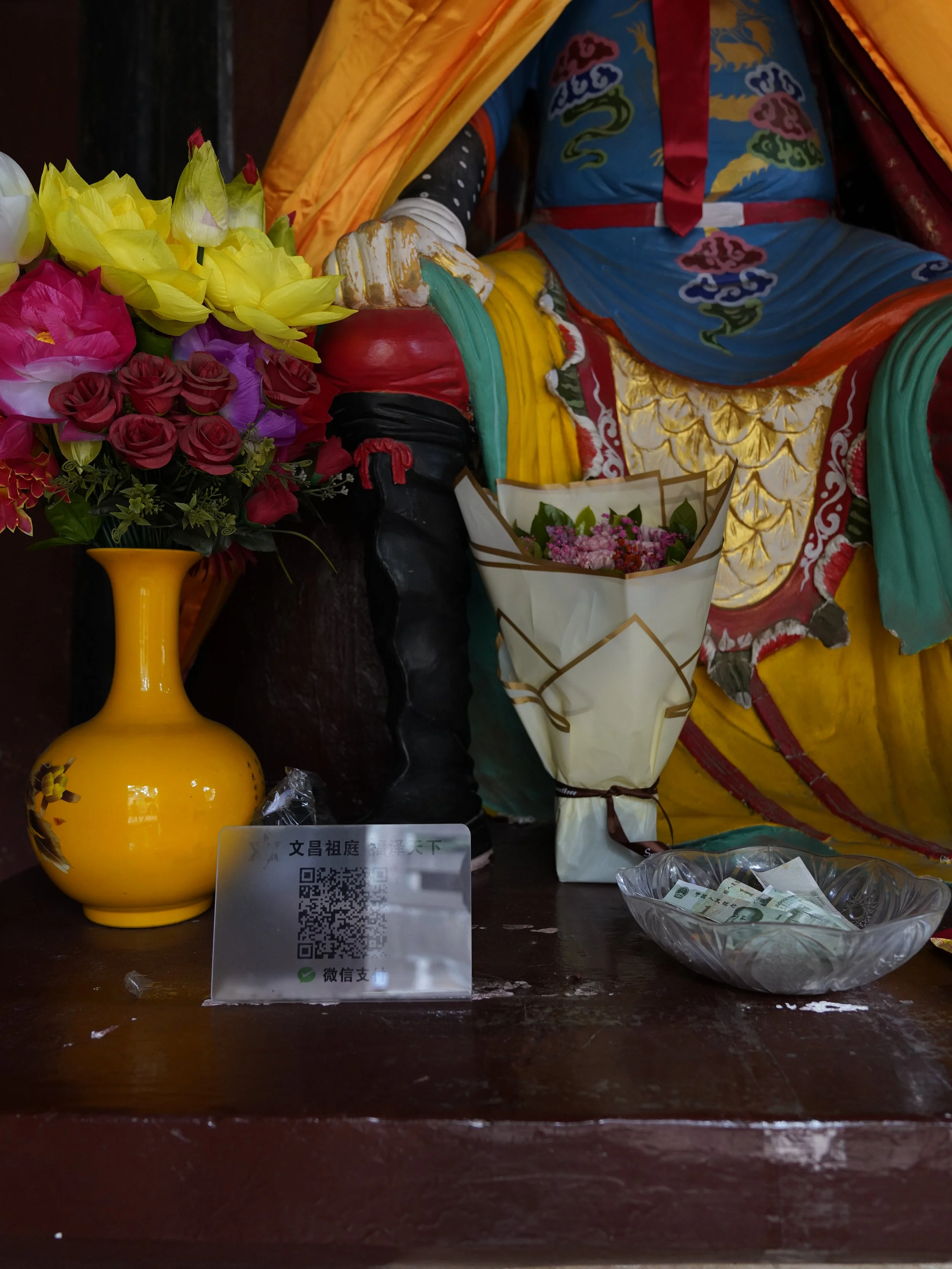
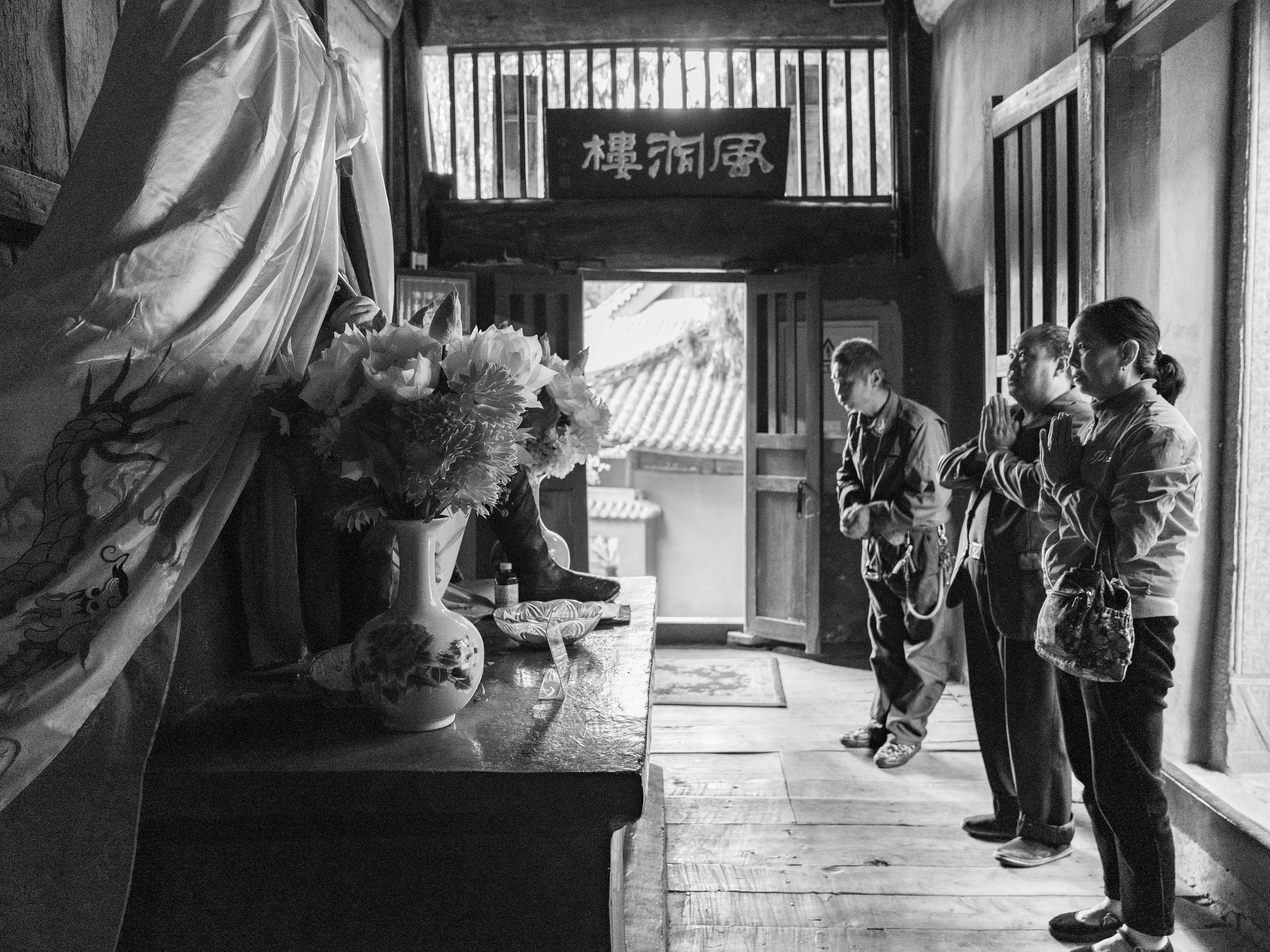
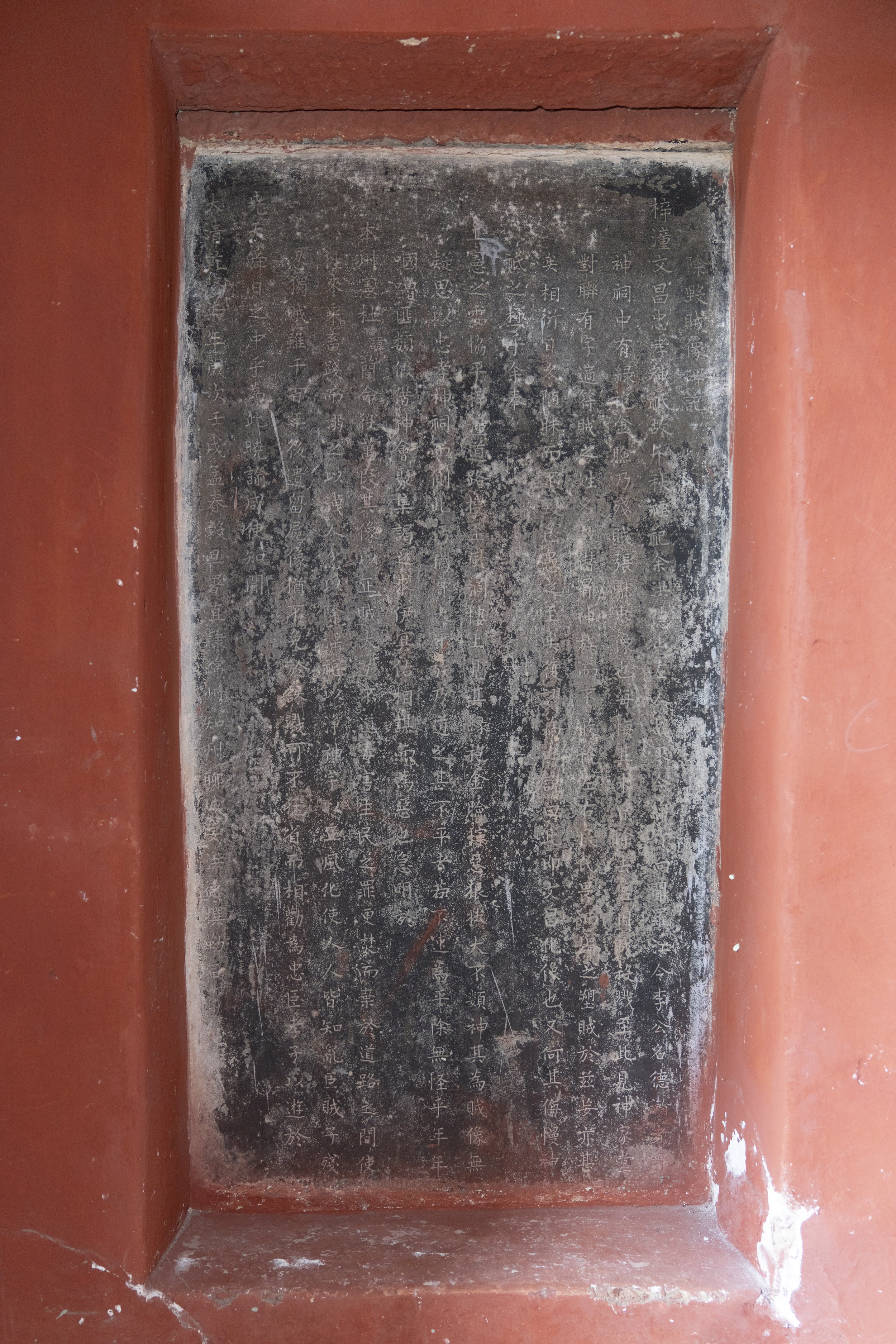
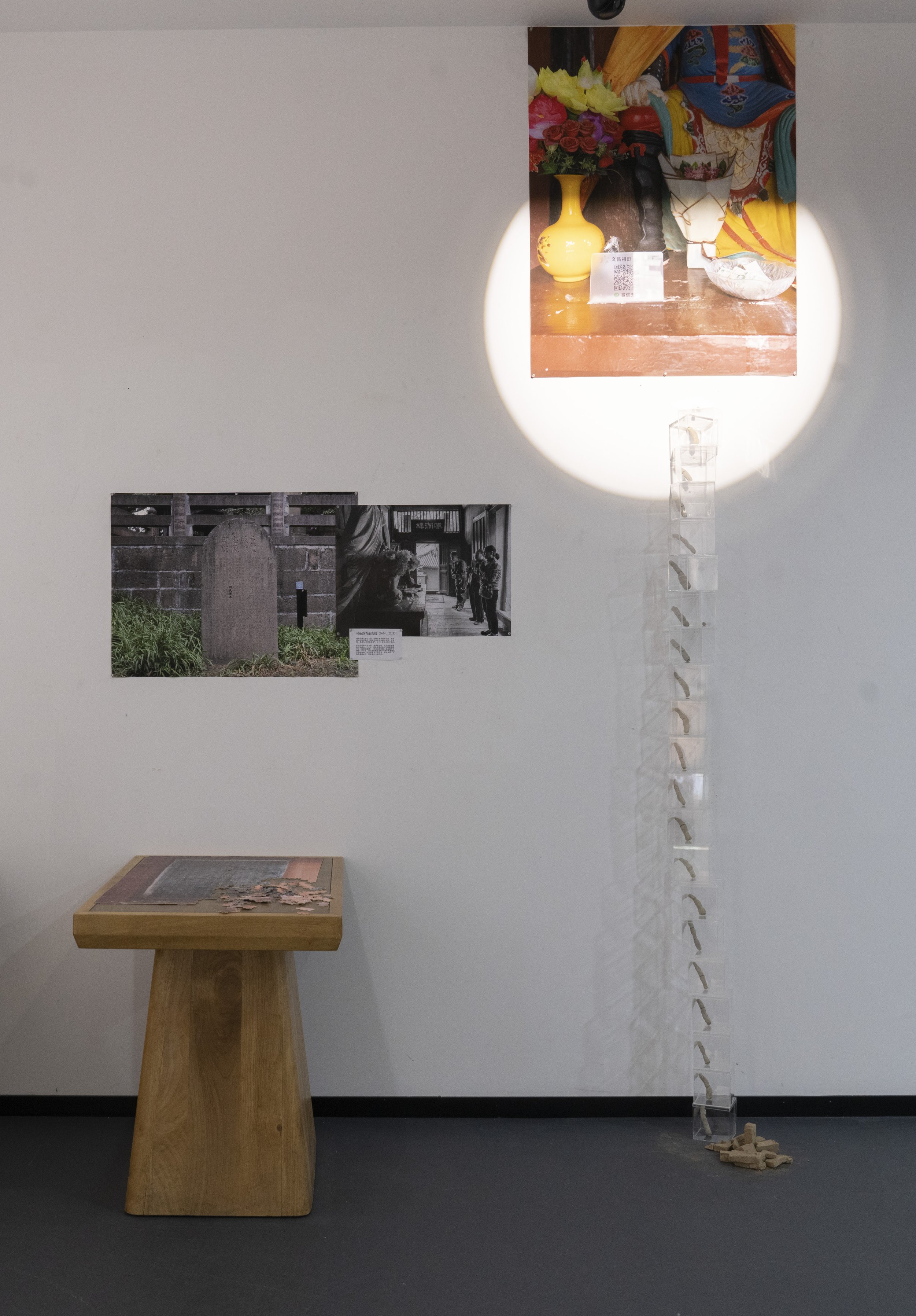
绵阳梓潼七曲山大庙,张献忠家庙嵌居于此。有传说因此地供奉的文昌帝君张亚子与献忠同姓,后者悦,尊其为“始祖高皇帝”,且下令保全本地人性命。
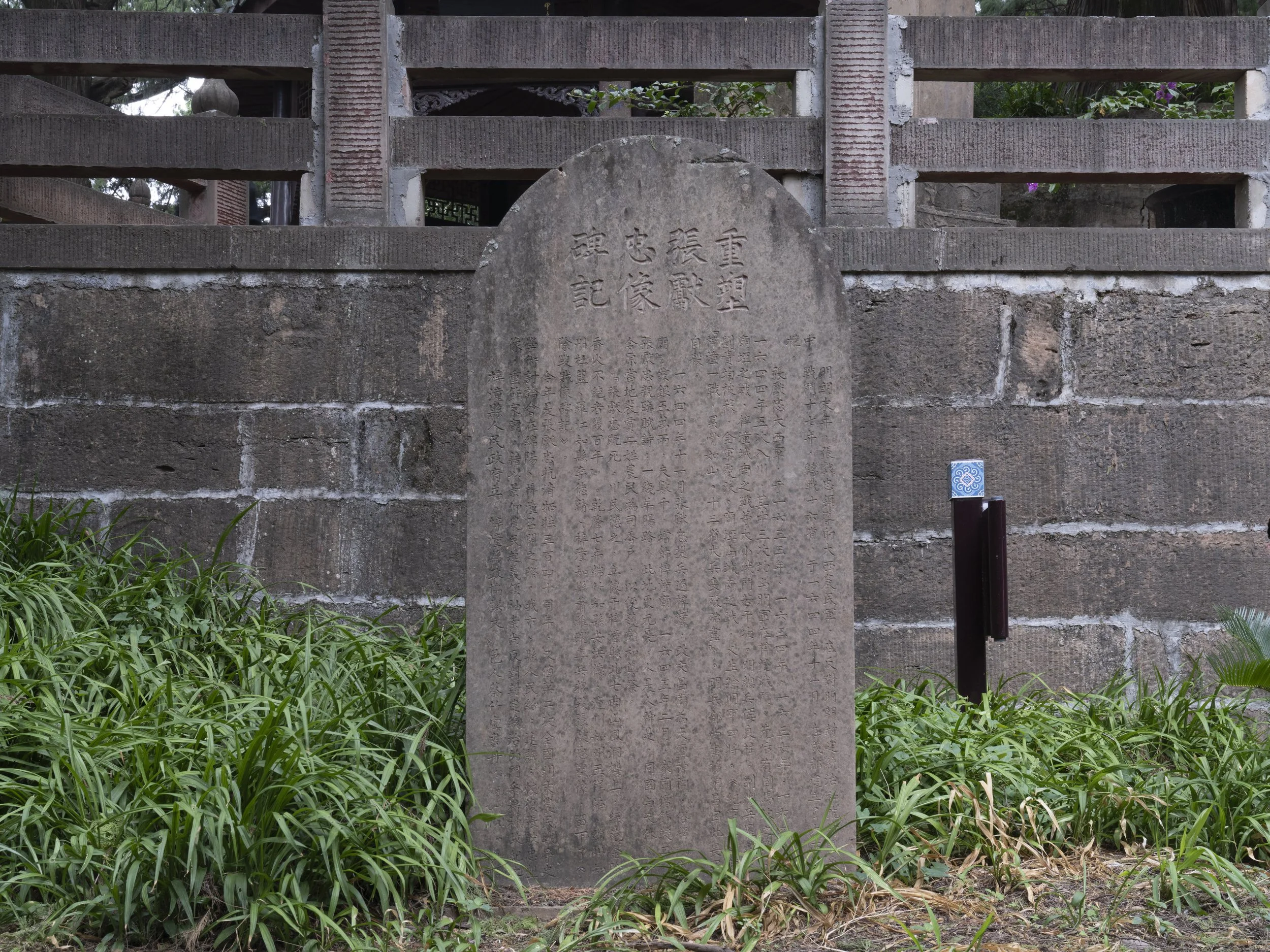
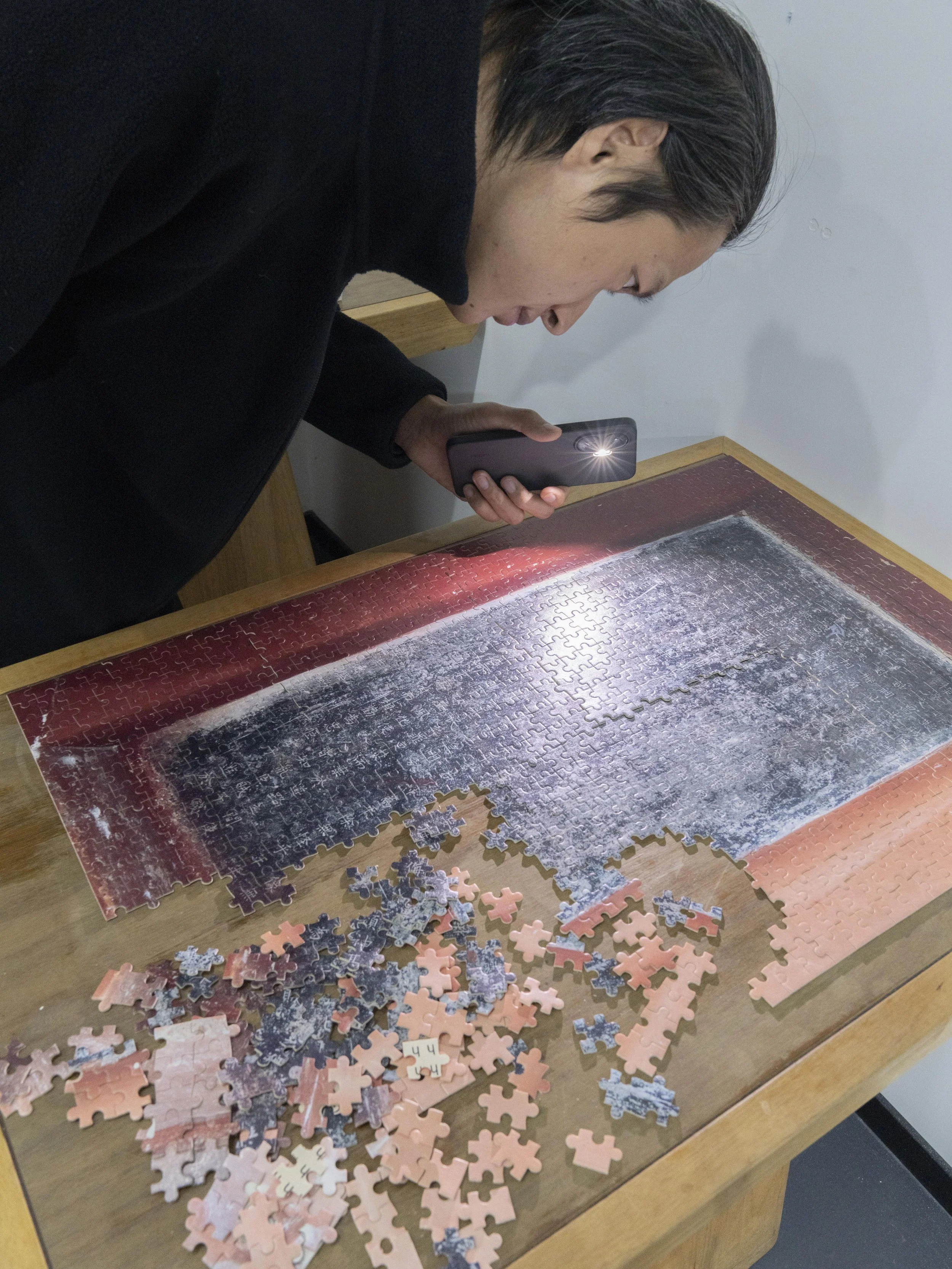
家庙历经数次毁与建:清康熙年间,民众秘密塑像祭祀张献忠;1741年,塑像遭绵州知州安洪德捣毁并立《除毁贼像碑》;抗日战争时期,家庙被改为佛堂;1987年,为纪念张献忠逝世340周年而重塑其金脸绿袍像。今日游客有入庙中者,偶有参拜。不知是逢庙必拜,还是真心念其旧好。
Within the Qiqu Mountain Temple in Zitong, Mianyang, embedded lies the ancestral temple of Zhang Xianzhong. Legend has it that because the deity enshrined here, Wenchang Dijun (Zhang Yazi), shared the same surname as Zhang Xianzhong, the latter was pleased. He honored Zhang Yazi as his "Exalted First Ancestor and Emperor" and ordered that the local people be spared.
This ancestral temple has undergone multiple cycles of destruction and reconstruction:
During the Kangxi reign of the Qing Dynasty, local people secretly made a statue of Zhang Xianzhong and offered sacrifices to it. In 1741, the statue was destroyed by An Hongde, the prefect of Mianzhou, who erected the "Stele for the Removal of the Bandit's Statue." During the War of Resistance against Japan, the temple was converted into a Buddhist hall. In 1987, to commemorate the 340th anniversary of Zhang Xianzhong's death, a new statue was crafted, depicting him with a golden face and green robes.
在玉局观的废墟上
Upon the Ruins of the Yuju Taoist Temple
2025
清人费密在《荒书》中记载:“十二月十五日,献忠杀进士、举人、贡生一万七千人于成都东门外。先是,贼以特科取士,使州县送人应试,自进士至生员,各州县皆调至,聚于玉局观,以兵围之。人见非试而欲杀,伺间伪为他事逃去者亦有二千人,于是移入城中大慈寺。迟数月,照牌点名出,杀之于江,人谓之’泣牌’。”
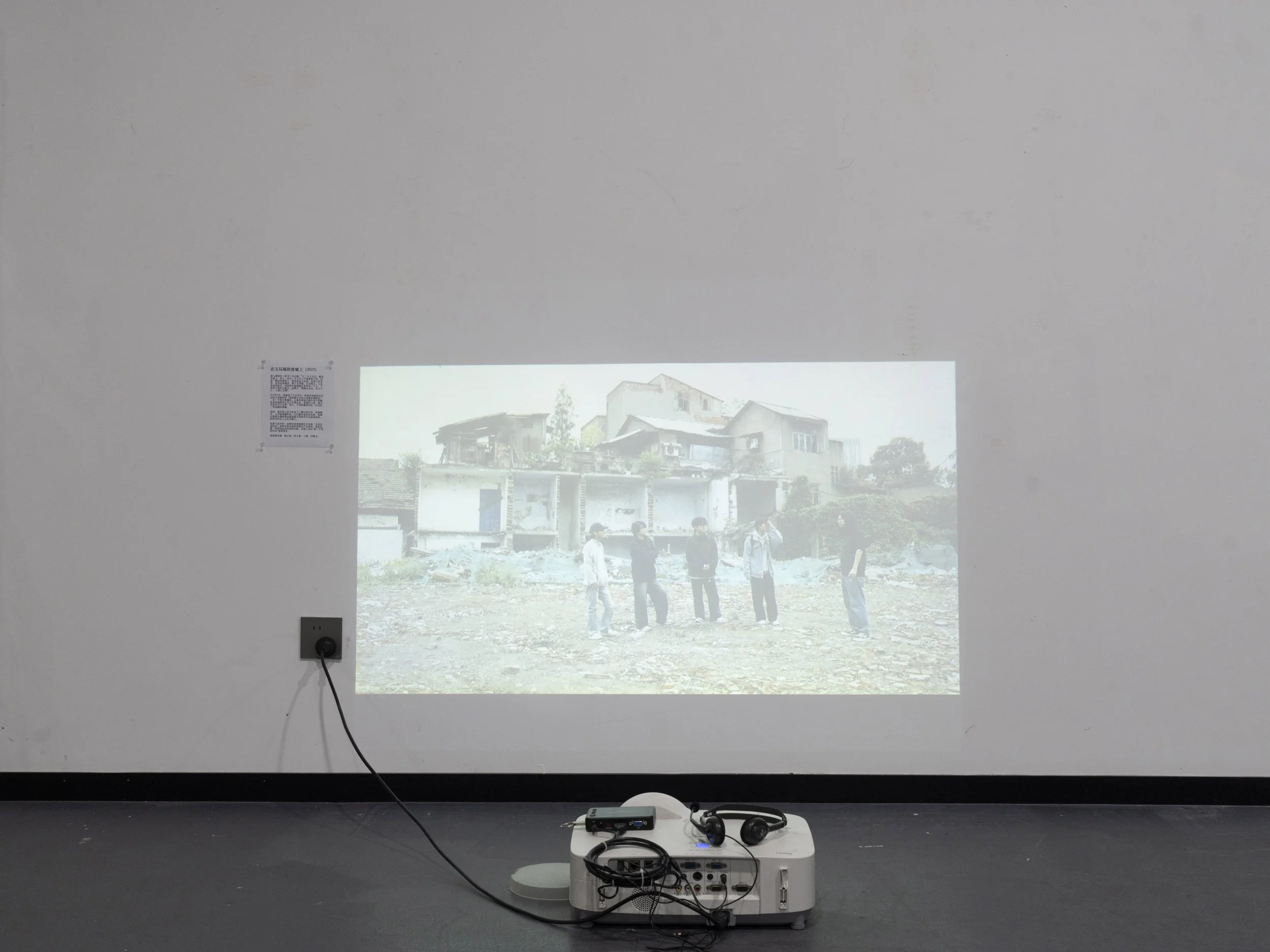
2025年4月,我邀请了几位学生一同前往成都市区北边的玉局观旧址(现成都火车站玉局庵东路附近),在一片拆迁废墟里,从简单讲述文献中对于张献忠在此地屠杀生员之旧事出发,请他们与我一道讨论各自对于灾难、死亡、个体和集体记忆(后记忆)等话题的理解。
其间,我们每人拿手机录下了聊天的声音,而视频中,人声很难被听到,它们被环境音所压制。视频以我借买烟的理由提前离开而留学生在原地结束,恰好当时有人正在关铁门。
在荷兰读书时,老师们非常强调艺术实践(不仅仅是作品)如何在更具体的范围内产生效果,我尝试做一些类似此次性质的实践,其意义会比“做一个好的作品”重要得多。
致谢杨昊睿、陈正阳、张子豪、丁洲、闫博文。
Fei Mi, a Qing dynasty scholar, recorded in his Book of the Wasteland:
“On the fifteenth day of the twelfth month, Zhang Xianzhong slaughtered seventeen thousand jinshi, juren, and gongsheng scholars outside the eastern gate of Chengdu. Prior to this, the bandit ruler had held a special imperial examination, ordering prefectures and counties to send candidates. Scholars, from the highest jinshi to local shengyuan, were gathered from all regions and confined within the Yuju Taoist Temple, surrounded by his troops. Sensing that this was not a true examination but a prelude to massacre, some two thousand candidates seized chances to escape under various pretexts. The remainder were then moved into the city’s Daci Temple. Months later, they were called out by name from a register and killed by the river. People referred to this as ‘Weeping Before the Nameplate’.”
In April 2025, I invited several students to join me at the historic site of the Yuju Taoist Temple—now located near Yuju’an East Road, adjacent to the Chengdu Railway Station, amid the rubble of a demolition zone. There, after briefly recounting the historical massacre of scholars by Zhang Xianzhong at this very location, I invited them to discuss with me their understanding of topics such as disaster, death, individual and collective memory (and post-memory).
During the conversation, each of us recorded the audio on our phones. In the video, however, our voices are nearly inaudible, overwhelmed by the ambient noise. The video ends with me leaving early under the pretext of buying cigarettes, leaving the students on-site—just as an iron gate was being closed nearby.
During my studies in the Netherlands, my tutors strongly emphasized how artistic practice—not just the final artwork—should generate effects within more concrete contexts. Attempting practices of this nature holds far greater significance for me than merely “producing a good artwork.”
Acknowledgments: Yang Haorui, Chen Zhengyang, Zhang Zihao, Ding Zhou, Yan Bowen.